Agentic commerce
readiness checklist.
readiness checklist.
Shoppers are starting to ask an assistant what to buy and letting it buy. Here is what that means, who is building the rails, and sixteen things to check before the first agent tries to check out on your store.
Guide · · 12 min read
What it is
Cited was step one.
Bought is step two.
Cited was step one.
Bought is step two.
For two years the question was whether an answer engine would cite your store when a shopper asked what to buy. That is AI search, and it is now a channel with its own crawlers, its own rules, and its own tracking. Agentic commerce is the step after: the assistant does not just recommend the product, it compares it, checks the return policy, and completes the purchase, often without the shopper ever seeing your site.
The mechanics are mundane. An agent reads the same web a crawler reads, without running JavaScript. It resolves the brand as an entity, reads the product as structured data, weighs reviews and policies it can parse, and hands the order to a checkout through a protocol the platform or payment provider exposes. Every one of those steps is a thing a store either has or does not have, and most of them can be checked from outside in seconds.
None of this replaces the storefront. Shoppers still browse, and the same rendering, schema, and content that make a store legible to an agent are what have made it rank for years. The difference is that the gaps now cost transactions directly. A product page with a price only in a script is not just slow to rank; it is a product the agent cannot buy.
Who is building it
Six rails.
One feed under all of them.
Six rails.
One feed under all of them.
Different companies, different protocols, the same requirements at the merchant end. Dates are when each was announced; how far each has rolled out changes monthly, and the readiness work does not.
OpenAI and Stripe
Announced September 2025
What it is
Instant Checkout in ChatGPT, built on the Agentic Commerce Protocol, an open specification the two companies published for agents to buy from merchants.
What it asks of you
A product feed in the protocol’s format and a checkout the agent can call. Stripe merchants have the shortest path; the protocol itself is payment-agnostic.
Google
Announced January 2026
What it is
The Universal Commerce Protocol, an open standard for agent-driven discovery and checkout across Google Search’s AI Mode, Gemini, and partner surfaces.
What it asks of you
Merchant Center data quality matters more, not less. The feed, the schema, and the page have to agree, and the checkout has to be callable.
Shopify
Announced December 2025
What it is
Agentic storefronts: the Shopify catalog and checkout exposed to agents such as ChatGPT, Microsoft Copilot, and Perplexity, with the merchant opting in from the admin.
What it asks of you
On Shopify, readiness is mostly catalog hygiene and an opt-in. On other platforms it is integration work.
Perplexity and PayPal
Announced 2025
What it is
Shopping inside Perplexity answers, with checkout through PayPal and Venmo for supported merchants.
What it asks of you
Being cited in Perplexity is the prerequisite; PerplexityBot has to be allowed and the product page has to be readable.
Amazon
Announced April 2025
What it is
Buy for Me, an agent that purchases from other brands’ websites on a shopper’s behalf when Amazon does not carry the item.
What it asks of you
An agent may fill your checkout like a customer would. Bot protection that blocks it also blocks the sale.
Visa and Mastercard
Announced April 2025
What it is
Intelligent Commerce and Agent Pay: payment credentials issued to agents so a purchase can be authorized on a shopper’s behalf with limits the shopper sets.
What it asks of you
Agent transactions will look different to fraud tooling. Rules tuned to block unusual sessions need revisiting.
The checklist
Found, read,
trusted, bought.
Found, read,
trusted, bought.
Sixteen checks in the order an agent applies them. The free AI visibility scan covers 8 of the 16 from outside in about ten seconds; the rest need your admin, your feed, or a person reading the answers.
01 · Found
An agent has to reach the store before it can read, compare, or buy. Most of this is robots.txt and rendering.
The answer engines’ crawlers are allowed
OAI-SearchBot, PerplexityBot, Claude-SearchBot, Googlebot, and Bingbot feed answers. A rule that blocks them removes the store from the conversation. Training agents (GPTBot, ClaudeBot, Google-Extended) are a separate decision.
How to check
Read robots.txt agent by agent, or run the free AI visibility scan, which lists each engine’s verdict.
In the free scanProduct facts are in the HTML the server sends
Most agents do not run JavaScript. If name, price, availability, and description appear only after scripts run, the agent sees a loading state.
How to check
View source (not inspect) on a product page and search for the price. The scan counts the readable words.
In the free scanOrganization and WebSite schema identify the brand
Agents resolve entities. Organization markup with a name, logo, and sameAs links to your profiles tells them this store is the brand, not a reseller of it.
How to check
Paste the homepage into a schema validator and look for Organization with sameAs. The scan checks both.
In the free scanA plain-text brief at /llms.txt
An emerging convention: a short text file describing who you are and what you sell, for engines that read it. Cheap to add, no downside.
How to check
Open yourstore.com/llms.txt. The scan reports whether it is there.
In the free scan
02 · Read
Once reached, the product has to be legible as data. Schema and feed are how an agent compares your item to the next one.
Product schema with an offer, a price, and availability
Price and availability are the two facts every agent needs before it recommends. Without them in the markup, the agent takes them from a marketplace listing instead.
How to check
Validate a product page. Look for Product, offers, price, priceCurrency, and availability. The scan reads one product page for exactly this.
In the free scanGTIN, MPN, or SKU on every product
Identifiers are how agents match the same item across stores. Without one, yours is an unverified listing beside verified ones.
How to check
Check the Product markup and the Merchant Center feed for gtin or mpn. The scan checks the markup.
In the free scanThe page, the schema, and the feed agree
A price in the markup that differs from the page, or a feed that says in stock when the size sold out, teaches the engine to distrust the store.
How to check
Compare price and availability across the page, the JSON-LD, and Merchant Center for a handful of products, including one that recently sold out.
Needs your adminFacts in the copy, not just the mood
Agents answer questions: materials, dimensions, compatibility, care, what is in the box. Copy that states these gets quoted; copy that sets a scene does not.
How to check
Ask an assistant a specific question about one of your products and see where the answer comes from.
Needs your admin
03 · Trusted
Before an agent recommends buying, it weighs the same things a careful shopper does, and it can only weigh what it can read.
Reviews in the markup, not only in a widget
AggregateRating and Review markup make reviews evidence. A reviews widget rendered by a script is invisible.
How to check
Look for aggregateRating on the Product node. The scan checks it.
In the free scanReturn and shipping terms as structured data
MerchantReturnPolicy and OfferShippingDetails are what an agent reads to answer “can I return it” and “when will it arrive” without guessing.
How to check
Check the offer for hasMerchantReturnPolicy and shippingDetails, and Merchant Center for the same policies. The scan checks the markup.
In the free scanPolicy pages that are pages
A returns policy in a PDF, shipping terms in an image, or an FAQ behind an accordion that loads on click are all unreadable to a crawler.
How to check
View source on the returns and shipping pages and confirm the text is in the HTML.
Needs your adminOne brand, one name, everywhere
The store, the marketplace listings, the social profiles, and the directories should agree on the name, the address, and what the business is. Disagreement reads as two entities.
How to check
Search the brand name in ChatGPT and Perplexity and read how they describe you. That is the citation baseline we run for free.
Needs your admin
04 · Bought
The last mile: the feed, the checkout, and the measurement that tells you whether any of it produced an order.
A complete, current product feed
Every protocol announced so far starts from a feed. Merchant Center on Google, the Shopify catalog on Shopify, the Agentic Commerce Protocol feed for ChatGPT. Missing attributes are missing products.
How to check
Open Merchant Center diagnostics and count disapprovals and missing attributes. On Shopify, check the catalog status in the admin.
Needs your adminA checkout an agent can call
Instant Checkout in ChatGPT and Google’s Universal Commerce Protocol complete the purchase inside the answer. That needs a checkout endpoint the protocol can call, or a platform that provides one.
How to check
On Shopify, review the agentic storefront settings in the admin. Elsewhere, ask your platform or payment provider which protocol they support and what the integration looks like.
Needs your adminBot protection that lets buying agents through
An agent filling your checkout looks like automation, because it is. Rules that challenge every headless browser will challenge the sale.
How to check
Review the bot-management rules on the checkout path and allow-list the agents you want to sell to as they publish their identities.
Needs your adminAI referrals and agent orders measured separately
If chatgpt.com and perplexity.ai traffic sits in “referral” with everything else, you cannot see whether this is working. Agent-completed orders need a channel of their own.
How to check
In GA4, create a channel group for AI referrers. In the order system, tag orders that arrive through a protocol.
Needs your admin
Take it with you
The checklist,
as a spreadsheet.
as a spreadsheet.
All sixteen checks with why each matters, how to check it, and whether the free scan covers it, plus columns for status, owner, and notes. Opens in Excel or Google Sheets. The guide above stays free to read; the working copy is what the email buys.
This quarter
Three moves,
in order.
Three moves,
in order.
Open the doors and fix the rendering
Rewrite robots.txt agent by agent, with training and search decided separately. Put name, price, availability, and description in the server HTML on every product page. This is a sprint, and it is where most stores are losing today.
Make the product legible as data
Organization and WebSite schema with sameAs. Product schema with offers, identifiers, reviews, and policies, checked against the page and the feed. Clean the feed in Merchant Center or the Shopify catalog until diagnostics are quiet.
Turn on a rail and measure it
Opt in on Shopify, or scope the integration for the protocol your platform and payment provider support. Split AI referrals into their own channel and tag agent orders, so the first one is visible when it lands.
THE QUESTIONS YOU HAVE -
Get them out
of the way.
of the way.
Start with the scan
Eight of the sixteen,
in ten seconds.
Eight of the sixteen,
in ten seconds.
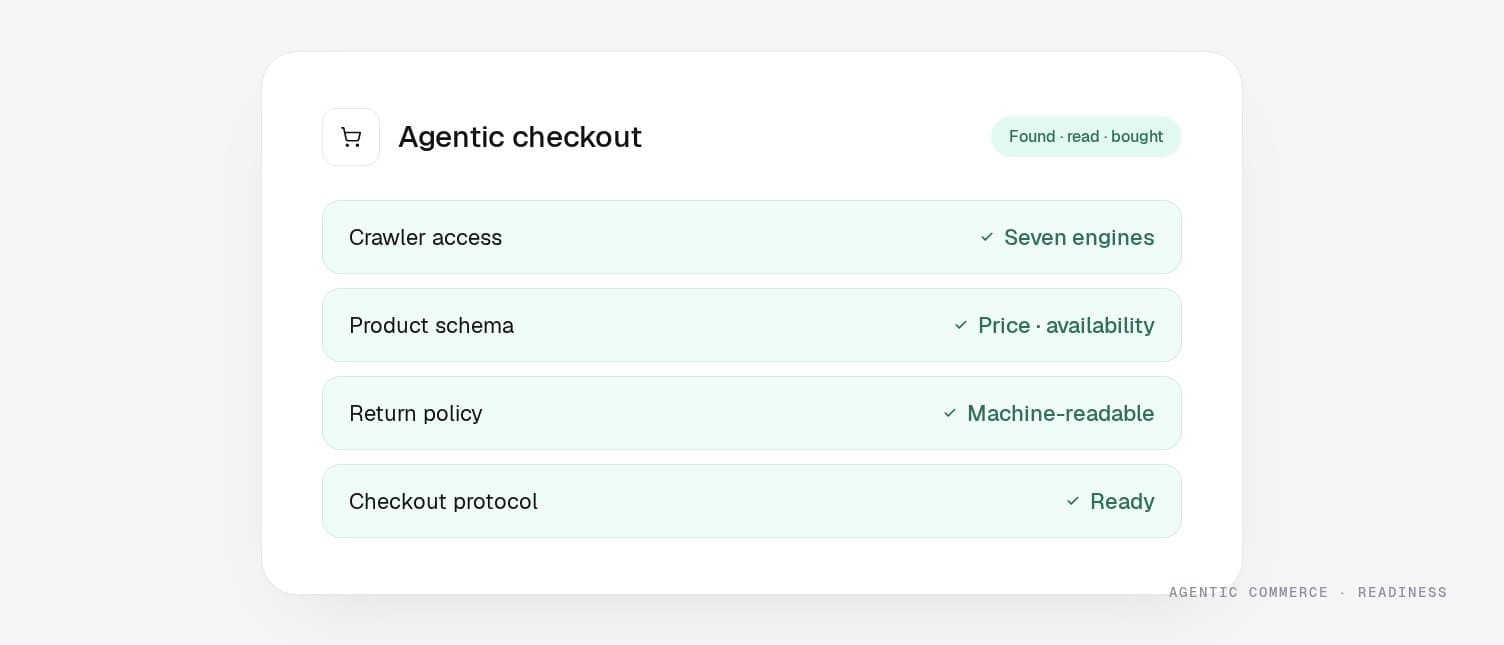
Paste your store's address and the free AI visibility scan reports crawler access for seven engines, what they can read, what your schema says, and what a product page carries. No email. The service page covers the rest.
Free citation baseline
Read it?
Now run it.
Now run it.
Say what you want done. A senior strategist replies within one business day with a citation baseline for your buyers’ real questions across ChatGPT, Perplexity, Gemini, and Claude. Free, and you keep it.
Already know what you want fixed? Say so here and we will scope that instead.