- Services
- Digital Marketing
- AI Search Optimization
Be the answer.
Not a footnote.
Not a footnote.
Shoppers now ask ChatGPT, Perplexity, and Google’s AI which brand to buy. We make sure your store is what they read, cite, and hand to checkout. Start with the free scan.






Where the shoppers went
“Which one should I buy?”
Answered without you.
Answered without you.
Product research is moving into chat. The answer engines read the same web, but they read it differently: no JavaScript, no patience for thin pages, and a preference for the brand whose facts are easiest to quote. Six ways a store falls out of the answer.
robots.txt blocks the crawler that feeds the answer
A rule copied in 2023 to keep training bots out also keeps OAI-SearchBot and PerplexityBot out of the index. The store is invisible in ChatGPT search and nobody notices, because there is no ranking report for it.
The product exists only after JavaScript runs
Most answer engines read the HTML the server sends and stop there. A storefront that renders its catalog in the browser hands them an empty shell and a loading spinner.
No Organization schema, so the brand is a guess
Answer engines resolve entities. Without Organization markup, sameAs links, and one consistent name across the web, the model is not sure who you are and cites a retailer that sells you instead.
Product pages with a price and no facts
Materials, dimensions, compatibility, and care are what a shopper asks about. If the page says “premium quality” and little else, the engine finds those facts on Amazon or a review site and sends the shopper there.
Reviews and policies the model cannot read
Reviews inside a widget, a returns policy in a PDF, shipping terms in an image. Trust signals a human sees and a crawler does not are trust signals you get no credit for.
Nobody is measuring citations
Rankings have Search Console. Citations in ChatGPT, Perplexity, Gemini, and Claude have nothing by default. Until you track the prompts your buyers type, you cannot tell whether any of this is working.
AI search optimization
Found. Cited.
Bought.
Found. Cited.
Bought.
Four groups of work, in the order the answer engines apply them: can they reach you, can they read you, do they trust you, and can they buy from you.
01 · Access
Let the right crawlers in
Each answer engine runs its own crawlers, and many stores block one of them by accident. Access is set per agent, on purpose, and checked after every deploy.
robots.txt policy per engine
llms.txt and site brief
Server-rendered storefront
Sitemaps and freshness signals
Core Web Vitals on field data
Bing index health for Copilot
02 · Readability
Write for the machine that quotes you
An answer engine lifts sentences. Product copy that states facts plainly gets lifted; copy that sets a mood does not.
Answer-ready product copy
Specs as structured facts
FAQ content on collections and PDPs
Comparison and buying-guide pages
Consistent brand descriptions everywhere
03 · Trust
Structured data that resolves the entity
Schema is how a store tells the engine who it is, what it sells, and on what terms. It has to agree with the page, every day.
Organization and WebSite with sameAs
Product with offers, GTIN, availability
Review and AggregateRating
MerchantReturnPolicy and shipping details
FAQPage and BreadcrumbList
Feed and schema parity checks
04 · Commerce
Agentic checkout readiness
The next step after being cited is being bought from inside the answer. That runs on feeds, schema, and the checkout protocols the platforms are shipping now.
Product feed completeness
Agentic Commerce Protocol readiness
Shopify agentic storefront setup
Universal Commerce Protocol readiness
Citation tracking across four engines
AI referral attribution in GA4
What goes wrong
Four ways to be
invisible. Handled.
Four ways to be
invisible. Handled.
These are the findings the free scan turns up most often. Each one is a change to the store, and each one is measurable before and after.
Blocked in robots.txt
What it costs you
Every answer engine you block is a channel you are not in, and there is no report that shows the shoppers who asked and were sent elsewhere.
What we do
We set the policy per crawler, on purpose: allow the search and user-fetch agents, decide separately about training bots, and check the file after every deploy.
An empty page until JavaScript runs
What it costs you
A storefront that renders in the browser reads as a blank page to a crawler that does not run scripts. Name, price, and stock are missing from what it quotes.
What we do
Server-render what matters: product name, price, availability, description, and schema in the HTML. On Shopify that is the theme doing its job; on headless it is the framework.
Schema that disagrees with the page
What it costs you
Product markup with yesterday’s price, availability that says in stock after the size sold out, a rating from a widget that was removed. Engines learn which stores to distrust.
What we do
One source of truth for the feed, the schema, and the page, checked automatically. Parity is most of the job.
No way to know if it worked
What it costs you
You cannot manage a channel you cannot see. Without citation tracking, AI search is optimized on faith.
What we do
A prompt set built from your buyers’ real questions, run on a schedule across ChatGPT, Perplexity, Gemini, and Claude, with citations logged and AI referrals split out in GA4.
Free tool
Scan first.
Then decide.
Then decide.
Paste your store’s address. In a few seconds you see which AI crawlers can reach it, whether the catalog is readable without JavaScript, what the structured data says about you, and what to fix first. No email needed.
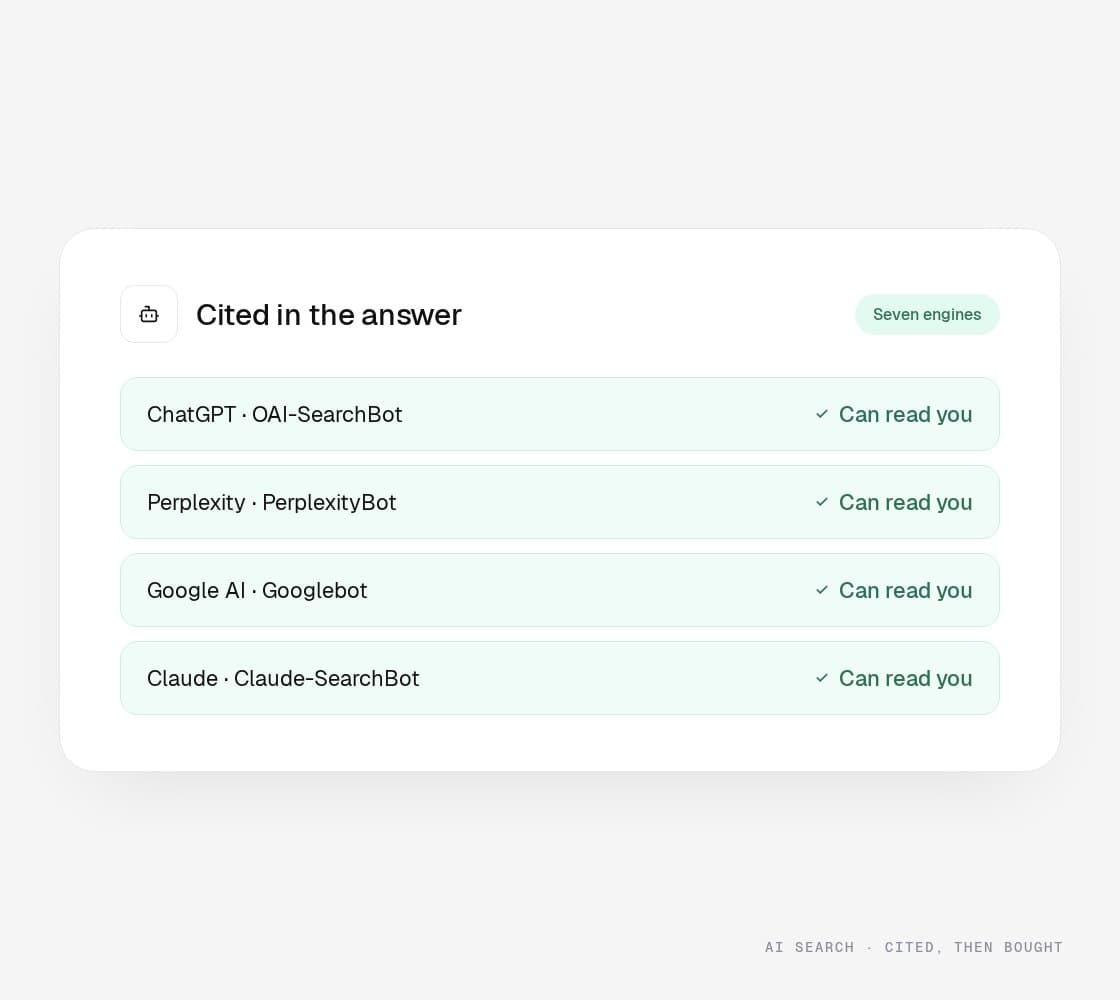
1. Crawler access, engine by engine
ChatGPT, Claude, Perplexity, Google AI, Copilot, Apple, and Meta, each with the verdict robots.txt gives it.
2. Readable without JavaScript
How much of the page a crawler that does not run scripts can read, and whether the H1 and the product facts are in it.
3. Entity and product schema
Organization, WebSite, Product, reviews, and policies, and whether the markup on a product page agrees with itself.
4. Catalog the agents can read
Sitemap, product URLs, and a machine-readable catalog where the platform exposes one.
5. What to fix first
Three findings, ordered by how much each moves the score, each with its measurement.
- Takes
- About ten seconds
- Costs
- Nothing. No email.
- Reads
- Public pages only
The scan reads what any visitor’s browser receives. It does not run prompts against the engines; the citation baseline after the scan does.
Try it now
Ten seconds.
No email.
Ten seconds.
No email.
Paste the address. The report opens on the scan page with every engine's verdict, the four scores, and what to fix first.
Free tool
Live scanOther options
Tools, traditional SEO, or us.
An honest read on the alternatives. Some of them are good at part of this.
Results
Show you the money.


DTC · SEO + CRO
+202%
traffic · month over month
A full SEO and CRO rebuild. Organic search now drives 25% of overall revenue, and AOV rose 30%.


DTC · Shopify Plus
2.4x
faster page loads · zero SEO loss
Replatformed an aging custom site to Shopify Plus without losing a single SKU or SEO ranking.
The big numbers
+30%
Avg. conversion rate lift within 12 months
+50%
Avg. order value lift
<1s
Page load speeds on the storefronts we build
+15%
Avg. revenue lift within 6 months
How it starts
Scan, baseline,
plan, report.
plan, report.
The scan is self-serve, the baseline is free, and the plan is written by the strategist who will run it.
Step 01
Free AI
visibility scanTen seconds, no email. Crawler access, rendering, schema, and catalog, with what to fix first.
Step 02
Citation
baselineWe run your buyers’ real questions across ChatGPT, Perplexity, Gemini, and Claude and show you who gets cited today. Free, and you keep it.
Step 03
90-day
planAccess, then schema, then content, then feed and checkout readiness, in that order, with what “done” looks like for each.
Step 04
Weekly citation
reportCitation share, sentiment, and AI referral revenue, from week one. Month to month, so the report has to earn the next one.
WE GOT THE WHOLE PACKAGE
There’s a lot more
to this story.
There’s a lot more
to this story.
Design, development, and digital marketing all live under one roof. The same team that builds your store also designs it and runs the paid, lifecycle, and CRO work behind it, so nothing gets lost in a handoff.
THE QUESTIONS YOU HAVE -
Get them out
of the way.
of the way.
Also on the menu
One team.
The rest of the work.
The rest of the work.
Each of these is its own page because people search for it by name. Behind the pages it is one team, so the SEO work knows what the developers shipped and the email flows know what the ads promised.
- View AI SEO
AI SEO
Rank for people. Get quoted by machines.
Learn more - View Generative Engine Optimization
Generative Engine Optimization
Be the source, not the summary.
Learn more - View LLM and ChatGPT Visibility
LLM and ChatGPT Visibility
Know what the engines say.
Learn more - View Ecommerce SEO
Ecommerce SEO
Organic revenue, not organic traffic.
Learn more - View Shopify SEO
Shopify SEO
SEO inside Shopify’s rules.
Learn more - View Conversion Rate Optimization
Conversion Rate Optimization
More orders from the traffic you already have.
Learn more - View Paid Media
Paid Media
Spend that earns its way back.
Learn more - View Email and SMS Marketing
Email and SMS Marketing
The flows that earn while you sleep.
Learn more
Free AI visibility scan
Cited yet?
Find out.
Find out.
Run the scan first; it takes seconds and asks for nothing. Then say what you want done about it, and a senior strategist replies within one business day with a citation baseline for your buyers’ actual questions.
Already know what you want fixed? Say so here and we will scope that instead.