- Services
- Digital Marketing
- Ecommerce SEO
Revenue from
organic search.
organic search.
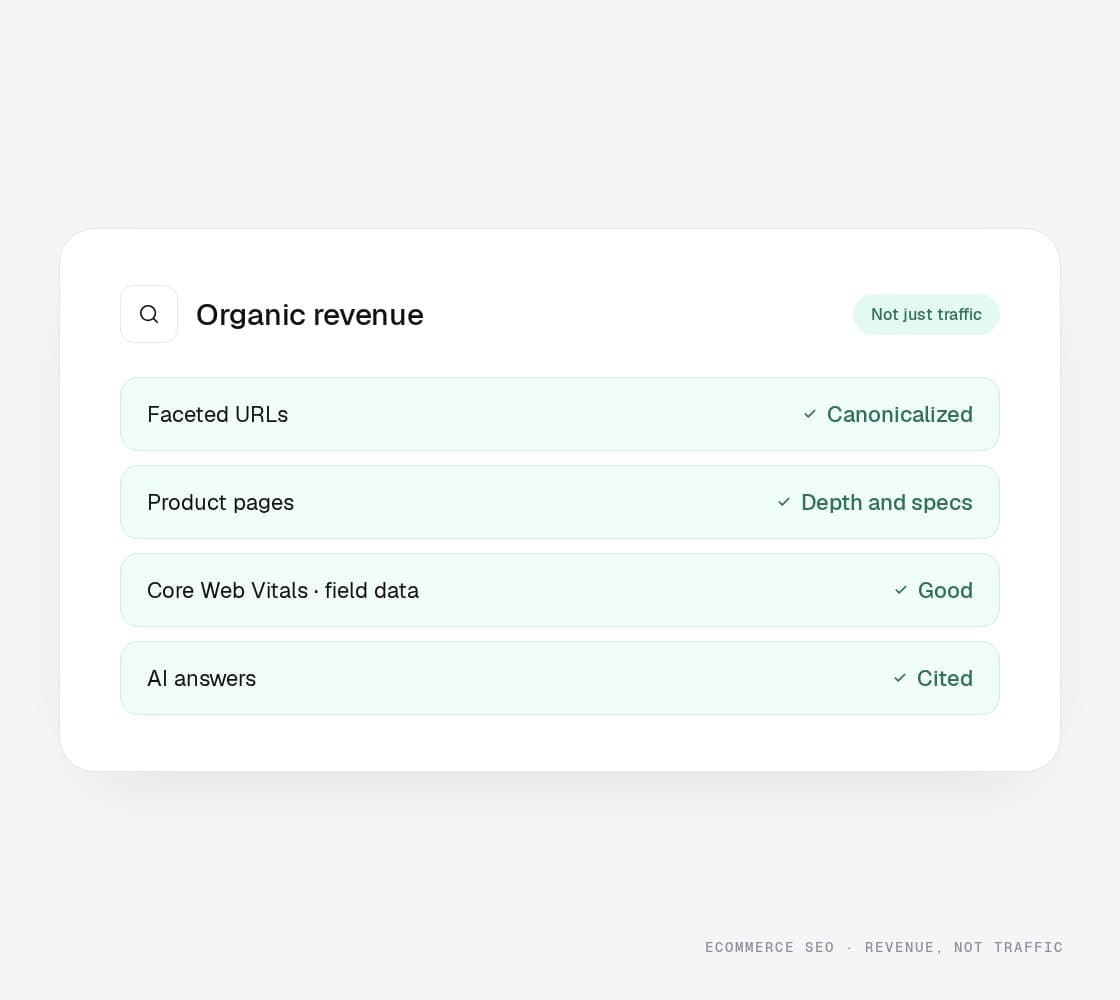
Ecommerce SEO for stores on Shopify, Adobe Commerce, BigCommerce, Commerce Cloud, and headless. Faceted navigation, product page depth, speed on real field data, and a migration plan that keeps the rankings you earned.
Proven Winners organic
25% of revenue







The traffic report
Traffic is up.
Revenue is flat.
Revenue is flat.
An ecommerce store has thousands of pages and the platform generates most of them: filters, sorts, variants, paginated collections. Search engines crawl all of it, rank little of it, and the pages that could sell get lost. Six ways it happens.
Faceted navigation minting URLs faster than Google can crawl them
Every filter combination is a page. Color times size times price band times sort is tens of thousands of near-duplicates, and the crawl budget goes there instead of to the collection pages that convert.
Collection pages with a heading and a grid
The page that should rank for the category term has forty product tiles and no words. There is nothing for a search engine to understand and nothing for a shopper to read before they scroll.
Product pages that say what the manufacturer said
A supplier description pasted onto two hundred retailers ranks for none of them. Specs, fit, care, and the questions buyers ask are the text that earns a product page its place.
Speed that passes in the lab and fails in the field
The Core Web Vitals in Google’s ranking signal come from real shoppers’ browsers, not from a Lighthouse run. A theme carrying a stack of app scripts fails on the phones customers actually own.
Internal links that follow the menu, not the money
The header links to the same six collections; everything else is three clicks deep. The pages with margin get no link equity, and the search engine takes the hint.
A replatform that treats redirects as a launch-day task
Rankings are lost in the redirect map, not in the platform choice. A map written the week before cutover misses the long tail, and the long tail is where most of the organic revenue lived.
Ecommerce SEO
Technical first.
Then the words.
Technical first.
Then the words.
Four groups, in the order they pay back: make the store crawlable, make the pages worth ranking, make them fast for real shoppers, and keep all of it through the next replatform.
01 · Technical
Crawlable, indexable, canonical
The platform decides how many URLs exist. We decide which of them deserve to be crawled and ranked, and make the rest disappear from the index without breaking the store.
Faceted navigation and crawl budget
Canonical and parameter handling
XML sitemaps by page type
Product, Offer, and Breadcrumb schema
Log-file and crawl analysis
International and hreflang
02 · On-page
Pages worth ranking
Collection copy a shopper would read, product pages with the facts a buyer asks about, and internal links that send authority to the pages with margin.
Collection page copy that reads
Product page depth: specs, fit, care, FAQs
Keyword mapping by intent
Internal linking to margin
Reviews and UGC that index
Content pruning and consolidation
03 · Speed
Core Web Vitals on field data
The ranking signal is measured on real shoppers’ devices over a rolling 28 days. We fix what moves that number: scripts, images, rendering, and the server.
CrUX field data, not lab scores
Theme and app script budgets
Image discipline and lazy loading
Server rendering for headless
Edge caching and time to first byte
04 · Growth
Links, content, and the next platform
The work that compounds: guides that earn links, migrations that keep rankings, and the AI answers now sitting above the results.
Buying guides and comparison content
Digital PR and link earning
Migration SEO: redirect maps and parity
AI answers and citations
Reporting on revenue, not sessions
What goes wrong
Four ways stores
lose rankings. Handled.
Four ways stores
lose rankings. Handled.
These are the findings the free audit turns up most often. Each one is a change to the store, and each one shows up in Search Console within a crawl cycle.
Thousands of filter URLs in the index
What it costs you
Crawl budget goes to color-and-size permutations while new products wait weeks to be discovered. Duplicate pages dilute the collection pages that should rank.
What we do
Decide which facets deserve a URL, canonicalize or noindex the rest, block the crawl paths that produce nothing, and check the result against the server logs after launch.
The collection page with no copy
What it costs you
The category term goes to a competitor with a few hundred words and a buying guide. Your page has a grid and a heading and sits on page three.
What we do
Written copy above and below the grid, FAQs on the page, and links to the guides that answer the buyer’s next question, without pushing products below the fold.
Lab score passing, field score failing
What it costs you
The ranking signal comes from real shoppers on real phones. A passing Lighthouse run hides a failing Largest Contentful Paint, and nobody opens the CrUX report.
What we do
Measure on field data, cut the app scripts that are not earning their weight, fix image sizing and render-blocking work, and watch the 28-day window move.
The migration that lost the long tail
What it costs you
Head terms were mapped; the product and collection URLs that quietly drove most of the organic revenue were not. Traffic falls for a quarter and nobody can say why.
What we do
Every indexed URL inventoried before the date is set, redirects and metadata carried across, internal links rewritten, crawl behavior watched through cutover. Anthony’s replatform came out with zero SEO loss.
Free SEO audit
Audit first.
Then a plan.
Then a plan.
Five business days, a senior SEO and an engineer who has shipped on your platform, and a document you keep: what is indexed, what is wasting crawl budget, where the pages fall short, and how fast the store really is for shoppers. Then a 90-day plan with revenue targets, not session targets.
1. Crawl and index review
What Google has indexed against what you meant to publish, with the gap explained URL type by URL type.
2. Faceted navigation and canonicals
Which filters deserve a page, which are duplicates, and how the platform is handling both today.
3. Collection and product page depth
The pages that should rank for your money terms, read against the pages that currently do.
4. Core Web Vitals on field data
The 28-day CrUX numbers for your templates, and the scripts and images behind them.
5. Structured data and AI readiness
Product, Offer, and Organization markup, and whether the answer engines can read the store at all.
6. A 90-day plan
Ordered by revenue at stake, with what “done” looks like for each item.
- Takes
- Five business days
- Costs
- Nothing, whether or not you hire us
- Run by
- A senior SEO and an engineer
The five days go on the parts a scan cannot see. The free website audit reads the outside of the store in ten seconds if you want to start there.
Other options
An SEO agency, a content mill, or us.
An honest read on the alternatives. The difference is who fixes what the audit finds.
Results
Show you the money.


DTC · SEO + CRO
+202%
traffic · month over month
A full SEO and CRO rebuild. Organic search now drives 25% of overall revenue, and AOV rose 30%.


DTC · Shopify Plus
2.4x
faster page loads · zero SEO loss
Replatformed an aging custom site to Shopify Plus without losing a single SKU or SEO ranking.


DTC · Magento
+51%
site revenue · first year
Overhauled Google, Microsoft, and Meta. ROAS went from 5:1 to 7:1, and a Reddit test added $123K on its own.
The big numbers
+30%
Avg. conversion rate lift within 12 months
+50%
Avg. order value lift
<1s
Page load speeds on the storefronts we build
+15%
Avg. revenue lift within 6 months
How it starts
Call, audit,
plan, wins.
plan, wins.
The audit is free and the plan is written by the strategist who will run it, with an engineer who has shipped on your platform.
Step 01
30-min
discovery callWhat you sell, where the organic revenue comes from today, and what the platform is doing to your URLs.
Step 02
Free SEO
auditCrawl, index, pages, and speed on field data. Five business days, and you keep the findings either way.
Step 03
90-day
proposalTechnical fixes first, then pages, then content. Revenue targets, weekly cadence, and what “done” looks like at the end of the quarter.
Step 04
First wins inside
30 daysIndex cleanup and speed fixes land before the content does, so the first report already has something to show.
WE GOT THE WHOLE PACKAGE
There’s a lot more
to this story.
There’s a lot more
to this story.
Design, development, and digital marketing all live under one roof. The same team that builds your store also designs it and runs the paid, lifecycle, and CRO work behind it, so nothing gets lost in a handoff.
THE QUESTIONS YOU HAVE -
Get them out
of the way.
of the way.
Also on the menu
One team.
The rest of the work.
The rest of the work.
Each of these is its own page because people search for it by name. Behind the pages it is one team, so the SEO work knows what the developers shipped and the email flows know what the ads promised.
- View AI Search Optimization
AI Search Optimization
Get cited where shoppers now ask.
Learn more - View AI SEO
AI SEO
Rank for people. Get quoted by machines.
Learn more - View Generative Engine Optimization
Generative Engine Optimization
Be the source, not the summary.
Learn more - View LLM and ChatGPT Visibility
LLM and ChatGPT Visibility
Know what the engines say.
Learn more - View Shopify SEO
Shopify SEO
SEO inside Shopify’s rules.
Learn more - View Conversion Rate Optimization
Conversion Rate Optimization
More orders from the traffic you already have.
Learn more - View Paid Media
Paid Media
Spend that earns its way back.
Learn more - View Email and SMS Marketing
Email and SMS Marketing
The flows that earn while you sleep.
Learn more
Free SEO audit
Indexed, sure.
Ranking?
Ranking?
Tell us the store and what hurts. Within one business day a senior SEO replies, and within five business days you have the audit: what is indexed, what wastes crawl budget, how fast the store is for real shoppers, and a 90-day plan. Yours to keep.
Mid-replatform? Say so. The redirect map and the parity checks are the first thing we scope.