- Services
- Digital Marketing
- Generative Engine Optimization
Be the source
they cite.
they cite.
GEO for ecommerce. Clean feeds, crawler access, and product facts machines can parse, so the answer is built from your store instead of about it. Start with the free scan.







Summarised, not sourced
Your category.
Someone else’s link.
Someone else’s link.
Generative engine optimization is the work of being the source an answer is assembled from. A store can be well known, well reviewed, and still never appear, because the engine could not lift a usable fact from it. Six reasons the citation goes elsewhere.
The facts are on the page, but not in the text
Dimensions in a spec image, materials in a tab that loads on click, compatibility in a PDF. An engine assembling an answer needs a sentence it can quote, and it will take one from a retailer that wrote it plainly.
The feed and the page disagree
Price, availability, and title differ between the product feed, the Product markup, and what the page renders. An engine that finds two answers to the same question trusts neither and cites a source that only gave it one.
Nothing establishes who you are
Without Organization markup, consistent sameAs links, and one spelling of the brand across the web, the model cannot resolve the entity. It falls back to a marketplace listing that carries your products under someone else’s name.
The category page is a grid and nothing else
A collection page with sixty tiles and no prose answers no question. The engine needs the criteria a shopper weighs, stated in the page, to use your category page as the source for a category question.
Third-party sources say more about you than you do
If the fullest description of your product is on a reseller, a review site, or a forum, that is what gets quoted, and the link goes there. Being outranked on your own facts is a content problem, not an authority problem.
No one has asked the engines what they say
GEO without measurement is a belief. Until the questions your buyers ask are run across the engines on a schedule and the cited domains are logged, there is no way to tell whether any of the work landed.
Generative engine optimization
Reachable. Readable.
Quotable.
Reachable. Readable.
Quotable.
GEO in the order an engine meets your store: it has to reach the page, parse what is on it, believe the facts agree, and find them worth quoting. Four groups of work, in that order.
01 · Reachable
Let the engines in, per engine
Every answer engine runs its own crawlers and many stores block one by accident. Access is set per agent, on purpose, written down, and re-checked after every deploy.
robots.txt policy per agent
Server-rendered catalog and templates
llms.txt and a plain-language site brief
Sitemaps and freshness signals
02 · Readable
Product facts a machine can lift
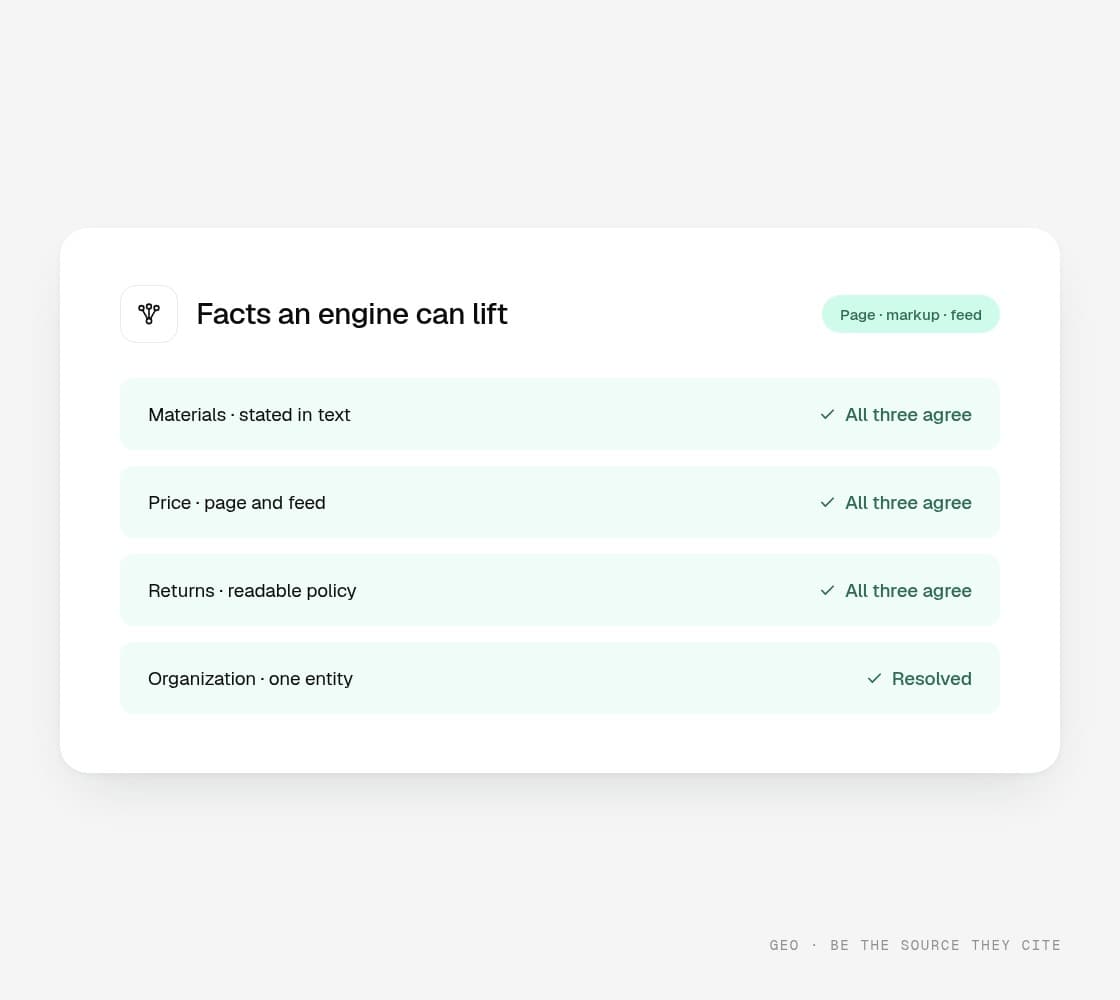
The centre of GEO for a store. Every attribute a shopper asks about stated as text on the page, in the markup, and in the feed, saying the same thing in all three.
Attributes as text, not as an image
Product schema generated from the page data
Feed hygiene across every channel
Shipping, returns, and warranty in readable text
Reviews outside the widget
03 · Believable
One brand, one set of facts
Engines resolve entities and cross-check them. The job is to make every source that mentions you agree, so the model has no reason to prefer a marketplace listing over the store itself.
Organization and WebSite markup
sameAs and profile consistency
Markup validated in CI so it cannot drift
Category pages that state the criteria
04 · Measured
Ask the engines, on a schedule
The only honest GEO report. Your buyers’ real questions, run across four engines on a fixed cadence, with every cited domain logged and the trend shown either way.
Prompt set built from your buyers’ questions
Citation share and who is cited instead
AI referral revenue split out in GA4
What goes wrong
GEO done badly.
Avoided.
GEO done badly.
Avoided.
The term is new enough that a lot of what is sold as GEO is either ordinary SEO with a new invoice, or tactics that quietly cost you the sale. Four we see most.
Pages rewritten for the machine
What it costs you
Question headings stacked on question headings, every fact restated three ways. Citation share may move; conversion falls, because the page now reads like documentation instead of a reason to buy.
What we do
Answer-first, then the selling. The opening states the fact plainly for whoever is reading, and the rest of the page does the job it always did.
A feed nobody reconciles
What it costs you
The engine reads a price from the feed, a different one from the markup, and a third from the page. Conflicting facts are worse than thin ones: the source stops being quotable at all.
What we do
One source of truth rendered into all three, with a check in CI that fails the build when the page and the markup disagree.
Blocking the training crawler and losing the index
What it costs you
A robots.txt rule written to stay out of model training also removed the store from the index that feeds answers, because the two jobs use different agents and one line caught both.
What we do
Access decided agent by agent and documented: which crawlers index, which train, which you are refusing, with the trade-off stated before anyone signs it off.
GEO measured by a vanity score
What it costs you
A dashboard shows a visibility number that goes up and nobody can say which answer changed or which question it came from. The programme is optimised toward the tool rather than the buyer.
What we do
Citation share against a fixed prompt set, with the raw answers kept. When a number moves you can read the answer that moved it.
Free tool
Scan first.
Then decide.
Then decide.
Paste your store’s address. In a few seconds you see which engines can reach it, whether the catalog is readable without JavaScript, what your structured data says about you, and what to fix first. No email needed.
1. Crawler access, engine by engine
The verdict your robots.txt gives each agent, including the three OpenAI runs for different jobs.
2. Readable without JavaScript
How much of the page a crawler that does not run scripts can read, and whether the product facts are in it.
3. Entity and product schema
Organization, WebSite, Product, reviews, and policies, and whether the markup agrees with the page.
4. Catalog the agents can read
Sitemap, product URLs, and a machine-readable catalog where the platform exposes one.
5. What to fix first
Three findings, ordered by how much each moves the score, each with its measurement.
- Takes
- About ten seconds
- Costs
- Nothing. No email.
- Reads
- Public pages only
The scan reads what any visitor’s browser receives. It does not run prompts against the engines; the citation baseline after the scan does.
Other options
A GEO tool, a content shop, or us.
An honest read on the alternatives. Some of them are good at part of this.
Results
Show you the money.


DTC · SEO + CRO
+202%
traffic · month over month
A full SEO and CRO rebuild. Organic search now drives 25% of overall revenue, and AOV rose 30%.


DTC · Shopify Plus
2.4x
faster page loads · zero SEO loss
Replatformed an aging custom site to Shopify Plus without losing a single SKU or SEO ranking.
The big numbers
+30%
Avg. conversion rate lift within 12 months
+50%
Avg. order value lift
<1s
Page load speeds on the storefronts we build
+15%
Avg. revenue lift within 6 months
How it starts
Here's what happens
after you fill out the form.
after you fill out the form.
Sales keeps it short. A senior strategist and an engineer who has shipped on your platform join the first call when the question needs them.
Step 01
30-min
discovery callWhat you’re on, what hurts, what the ERP and the catalog look like. We’ll say early if the platform isn’t the problem.
Step 02
Free platform audit
Pricing logic, catalog, integrations, Core Web Vitals on real field data. Five business days. Yours to keep.
Step 03
Stay, upgrade,
or moveOne recommendation, with the cost of staying set against the cost of moving. Sometimes the answer is stay.
Step 04
Scoped
proposalScope, timeline, pricing: fixed-fee or T&M. First wins inside 30 days.
WE GOT THE WHOLE PACKAGE
There’s a lot more
to this story.
There’s a lot more
to this story.
Design, development, and digital marketing all live under one roof. The same team that builds your store also designs it and runs the paid, lifecycle, and CRO work behind it, so nothing gets lost in a handoff.
THE QUESTIONS YOU HAVE -
Get them out
of the way.
of the way.
Also on the menu
One team.
The rest of the work.
The rest of the work.
Each of these is its own page because people search for it by name. Behind the pages it is one team, so the SEO work knows what the developers shipped and the email flows know what the ads promised.
- View AI Search Optimization
AI Search Optimization
Get cited where shoppers now ask.
Learn more - View AI SEO
AI SEO
Rank for people. Get quoted by machines.
Learn more - View LLM and ChatGPT Visibility
LLM and ChatGPT Visibility
Know what the engines say.
Learn more - View Ecommerce SEO
Ecommerce SEO
Organic revenue, not organic traffic.
Learn more - View Shopify SEO
Shopify SEO
SEO inside Shopify’s rules.
Learn more - View Conversion Rate Optimization
Conversion Rate Optimization
More orders from the traffic you already have.
Learn more - View Paid Media
Paid Media
Spend that earns its way back.
Learn more - View Email and SMS Marketing
Email and SMS Marketing
The flows that earn while you sleep.
Learn more
Free AI visibility scan
Cited yet?
Find out.
Find out.
Run the scan first; it takes seconds and asks for nothing. Then say what you want done about it, and a senior strategist replies within one business day with a citation baseline built from your buyers’ actual questions.
Already know what you want fixed? Say so here and we will scope that instead.