- Platforms
- BigCommerce
Hosted,
without the
handcuffs.
without the
handcuffs.
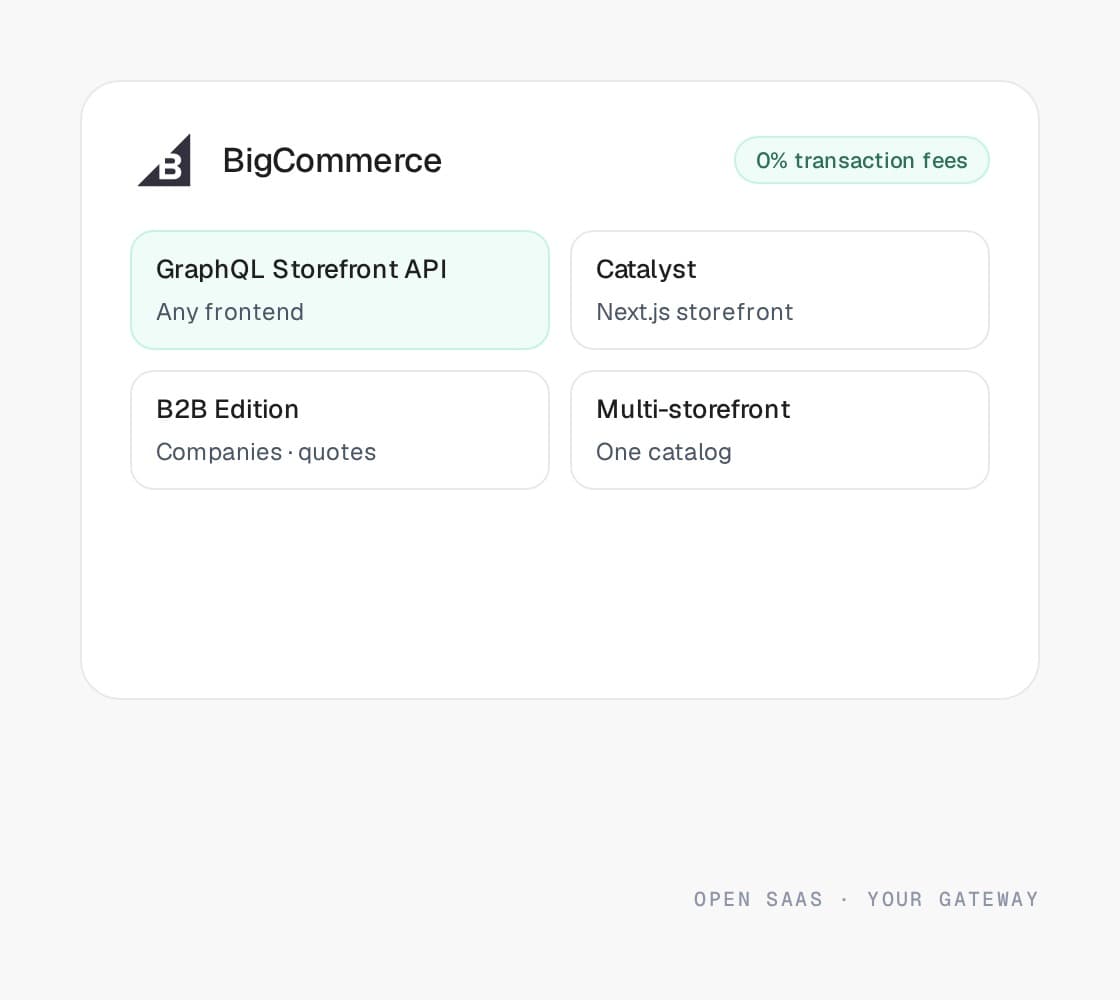
BigCommerce development: Catalyst and Next.js storefronts, Stencil themes, B2B Edition, and multi-storefront. Open SaaS for merchants who expect to outgrow a theme.





Why open SaaS
Hosted infrastructure,
open APIs.
open APIs.
BigCommerce sits between the two poles this page set keeps describing. You get SaaS operations, and you do not get a frontend the platform dictates. These are the situations where that combination is the right one.
You want React on the frontend without funding a bespoke architecture
Catalyst is the Next.js storefront framework with the component library and integrations already done. It is the shortest honest path to a headless storefront on any platform in this set.
You are paying transaction fees on top of your payment processor
BigCommerce charges none, and lets you keep your own gateway. On a nine-figure catalog that difference stops being a rounding error.
You run several brands or regions off one catalog
Multi-storefront is native rather than an expansion-store workaround, and the catalog stays in one place instead of being synced between copies.
Your wholesale operation is real but not baroque
B2B Edition covers company accounts, price lists, quotes, and purchase orders. If you also need punchout into Ariba and pricing resolved live from an ERP, Adobe Commerce is still the better answer and we will say so.
You need the platform to stay out of the way of SEO
Clean URLs, control over canonicals and metadata, and a fast hosted stack put the outcome in the build’s hands. What decides it is migration discipline and Core Web Vitals on real devices, both of which are engineering.
BigCommerce capabilities
Everything your store needs.
On BigCommerce.
Everything your store needs.
On BigCommerce.
Design, development, and marketing on BigCommerce, from one team. The frontend decision comes first, because it decides what the next three years cost you.
01 · Design
Stencil or Catalyst, designed for conversion
Two frontends, one standard: the design has to earn its conversion rate on the phone in someone’s hand.
Theme and storefront design for Stencil or Catalyst
PDP and category page UX
B2B Edition buyer-portal design
Mobile-first design systems
WCAG 2.2 AA accessibility, designed in
02 · Development
Catalyst, Stencil, and everything underneath
Catalyst, or our own Next.js storefront, which connects to BigCommerce the same way and starts from something that already works.
Catalyst storefronts on Next.js
Stencil theme development
B2B Edition: companies, price lists, quotes
Multi-storefront from one catalog
ERP, OMS, and 3PL middleware
Migrations with the redirect map scoped first
03 · Marketing
Feeds, search, and the numbers behind them
BigCommerce stays out of the way of SEO, which puts the outcome in the marketing team’s hands. That is us.
BigCommerce SEO: URLs, canonicals, structured data
Google Shopping and Meta feeds, Feedonomics-ready
Klaviyo email and SMS
CRO across PDP, cart, and checkout
GA4, GTM, and PostHog instrumentation
The big numbers
+30%
Avg. conversion rate lift within 12 months
+50%
Avg. order value lift
<1s
Page load speeds on the storefronts we build
+15%
Avg. revenue lift within 6 months
Known issues
The issues you'll hit.
Handled.
The issues you'll hit.
Handled.
BigCommerce trades a smaller ecosystem for an open one. These are the places that trade shows up in practice, and what we do so it doesn’t cost you.
API rate limits on integrations
What it costs you
Per-store API quotas cap how fast an ERP or PIM can push updates, so large catalogs sync slowly and real-time inventory is not actually real time.
What we do
Batched and prioritized sync with webhooks for the changes that matter now, so the quota goes to stock and price, not to noise.
Variants per product
What it costs you
BigCommerce caps variants per product, which is generous until a configurable product with several options blows through it and has to be split.
What we do
Option architecture designed to the cap up front: modifiers for non-inventory choices, variants only for what actually tracks stock.
B2B Edition as a separate app
What it costs you
B2B Edition adds a buyer portal with its own UI and rules, so the B2B experience can feel bolted on and quotes, price lists, and accounts live in two places.
What we do
We design the buyer portal into the storefront so it reads as one product, and wire the data so accounts and price lists have a single source of truth.
Checkout you can only customize so far
What it costs you
The optimized one-page checkout is fast and mostly fixed. Custom fields, complex shipping logic, or B2B terms hit the edge of what the Checkout SDK allows.
What we do
We scope checkout requirements before build, use the SDK where it fits, and design around it honestly where it doesn’t rather than promising a workaround.
Faceted navigation eating crawl budget
What it costs you
Filter combinations generate thousands of indexable URLs, so Google spends its time on facet pages and your category pages lose rank.
What we do
Facet indexing rules, canonicals, and internal linking that point authority at the category pages that should rank.
Keeping Catalyst current
What it costs you
A Catalyst storefront is a Next.js codebase. Framework and dependency updates keep arriving, and an unmaintained one drifts behind the API within a year.
What we do
Catalyst on a retainer, with upgrades and dependency work scheduled, or Stencil if you would rather not own a frontend at all. We say which before you choose.
WE GOT THE WHOLE PACKAGE
There’s a lot more
to this story.
There’s a lot more
to this story.
Design, development, and digital marketing all live under one roof. The same team that builds your store also designs it and runs the paid, lifecycle, and CRO work behind it, so nothing gets lost in a handoff.
THE QUESTIONS YOU HAVE -
Get them out
of the way.
of the way.
Other platforms
Coming from
one of these?
one of these?
Most moves to BigCommerce start on one of these. We build on all of them, so the migration plan is written by people who know both sides of it.
- View Shopify
Shopify
The default for brands that would rather ship than patch.
Learn more - View Adobe Commerce
Adobe Commerce
Where catalog depth and pricing complexity still decide it.
Learn more - View Salesforce Commerce Cloud
Salesforce Commerce Cloud
The right answer when the rest of the business already runs on Salesforce.
Learn more - View Shopware
Shopware
Open source with the B2B rules engine built in, not bolted on.
Learn more - View Headless & Composable
Headless & Composable
Fast enough to outrank them. Cheap enough to actually do it.
Learn more
Migration plans
Head to head
Free BigCommerce audit
BigCommerce
now, or next?
Start here.
now, or next?
Start here.
Already on BigCommerce? Five business days, a senior engineer, and a document you keep, covering what the store runs on, what it is costing you, and what to fix first.
Moving to BigCommerce? The same five days scope the build, the integrations, and a migration that keeps your rankings.