- Platforms
- Salesforce Commerce Cloud
One estate,
or none of
the upside.
or none of
the upside.
Salesforce Commerce Cloud engineering: SFRA and PWA Kit storefronts, cartridge development, SCAPI and OCAPI integration. Worth it when the rest of the business already runs on Salesforce.






The one reason that holds
Commerce Cloud is
an integration decision.
an integration decision.
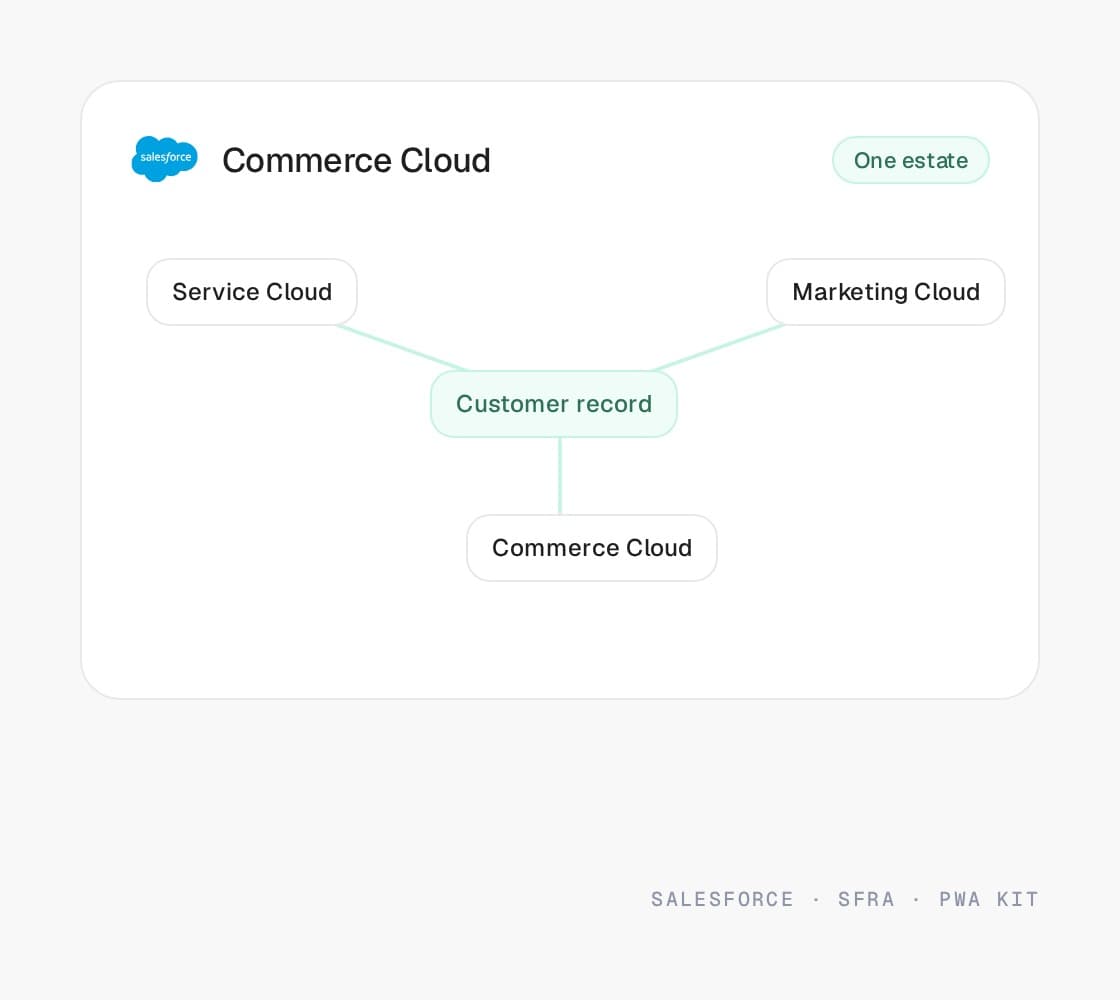
Nobody picks this platform for the storefront. They pick it because Service Cloud, Marketing Cloud, and the CRM are already the system of record, and having commerce in the same estate is worth more than a better frontend. If that is not your situation, it is the wrong platform and we will tell you so.
Support, marketing, and commerce all reading the same customer record
This is the whole case. No integration layer to build, no identity reconciliation, no nightly sync between the storefront and the system your service team actually uses.
A revenue-share model that changes the math as you grow
Pricing is against gross merchandise value rather than a flat license, so platform cost scales with success in a way flat-fee platforms do not. Worth modeling honestly before signing, and we have no incentive in the outcome.
A cartridge stack nobody has audited since implementation
Customization that drifted into vendor cartridges instead of your own is the single most common reason a Commerce Cloud upgrade turns into a project. Untangling it is the first thing an inherited implementation needs.
SFRA and PWA Kit treated as old and new rather than as a choice
SFRA is not legacy. PWA Kit is not automatically better. The deciding factor is how much frontend engineering you intend to own, which is the same question every headless decision comes down to.
Integrations split across OCAPI and SCAPI with no plan
Most real estates run both during the transition. Some of those integrations are worth moving to SCAPI and some are fine where they are, and knowing which is which saves a quarter.
Commerce Cloud capabilities
Everything your store needs.
On Commerce Cloud.
Everything your store needs.
On Commerce Cloud.
Design, development, and marketing on Salesforce Commerce Cloud, from one team. The estate is the point, so the marketing work lives inside it.
01 · Design
Enterprise storefronts, designed for the estate
Multi-brand and multi-locale from day one, on components Page Designer can actually reuse.
SFRA and PWA Kit storefront design
Page Designer components and content architecture
Multi-brand, multi-locale design systems
Mobile-first, with Core Web Vitals in the brief
WCAG 2.2 AA accessibility, designed in
02 · Development
Storefront, cartridges, and the API surface
Enterprise integration work, mostly. The storefront is rarely the hard part on this platform, and the estate around it usually is.
SFRA storefront development
PWA Kit and Managed Runtime
Custom cartridge development, upgrade-safe
SCAPI and OCAPI integration
ERP, OMS, and PIM connections
Takeover and audit of inherited implementations
03 · Marketing
Marketing Cloud, wired to the storefront
The one-estate advantage is a marketing advantage. Journeys, recommendations, and attribution all read the same customer record.
Marketing Cloud journeys, email, and SMS
Einstein recommendations and merchandising
SEO across multi-site, multi-locale catalogs
Paid media with Service Cloud attribution
GA4, GTM, and PostHog instrumentation
The big numbers
+30%
Avg. conversion rate lift within 12 months
+50%
Avg. order value lift
<1s
Page load speeds on the storefronts we build
+15%
Avg. revenue lift within 6 months
Known issues
The issues you'll hit.
Handled.
The issues you'll hit.
Handled.
Commerce Cloud’s issues are rarely about the storefront. They are about cost, people, and the estate around it, which is exactly where an implementation goes quiet.
Cost that scales with your revenue
What it costs you
GMV-based pricing means the platform bill grows with every good quarter, and renewal conversations happen from a weaker position each year.
What we do
We model the revenue share against your growth plan before commitment or renewal, and make sure the estate advantage is real enough to justify it.
Developers you can’t hire
What it costs you
Certified Commerce Cloud engineers are scarce and expensive, so roadmaps stall on availability rather than priority.
What we do
A team that has shipped on the platform, on retainer, so the roadmap moves on your calendar rather than the job market’s.
Cartridge conflicts on every release
What it costs you
Customization drifted into vendor cartridges, so each platform release breaks something and the upgrade turns into a project.
What we do
Customization isolated in your own cartridges with a clear overlay order, so releases apply cleanly and the diff is knowable.
Still on SiteGenesis
What it costs you
Legacy SiteGenesis storefronts are slow to change and off the path Salesforce invests in, and every new feature costs more than it should.
What we do
A planned SFRA or PWA Kit migration, scoped feature by feature, so the storefront moves without a big-bang rewrite.
Third-party tags dragging performance
What it costs you
Enterprise storefronts accumulate marketing and analytics tags for years, and SFRA’s server render gets blamed for a slow page it didn’t cause.
What we do
Tag governance through the tag manager, server-side where possible, and Core Web Vitals measured in the field so the real culprit is the one that gets fixed.
Business Manager nobody understands
What it costs you
Promotions, campaigns, and content slots configured over years by people who have left, so nobody dares touch anything.
What we do
An audit that documents what is live and why, then cleanup and training so the merchandising team runs it with confidence.
WE GOT THE WHOLE PACKAGE
There’s a lot more
to this story.
There’s a lot more
to this story.
Design, development, and digital marketing all live under one roof. The same team that builds your store also designs it and runs the paid, lifecycle, and CRO work behind it, so nothing gets lost in a handoff.
THE QUESTIONS YOU HAVE -
Get them out
of the way.
of the way.
Other platforms
Coming from
one of these?
one of these?
Most moves to Salesforce Commerce Cloud start on one of these. We build on all of them, so the migration plan is written by people who know both sides of it.
- View Shopify
Shopify
The default for brands that would rather ship than patch.
Learn more - View Adobe Commerce
Adobe Commerce
Where catalog depth and pricing complexity still decide it.
Learn more - View BigCommerce
BigCommerce
Open SaaS, with a headless path that does not fight you.
Learn more - View Shopware
Shopware
Open source with the B2B rules engine built in, not bolted on.
Learn more - View Headless & Composable
Headless & Composable
Fast enough to outrank them. Cheap enough to actually do it.
Learn more
Migration plans
Head to head
Free Commerce Cloud audit
Commerce Cloud
now, or next?
Start here.
now, or next?
Start here.
Already on Commerce Cloud? Five business days, a senior engineer, and a document you keep, covering the cartridge stack, what the estate is costing you, and what to fix first.
Moving to Commerce Cloud? The same five days scope the build, the integrations, and a migration that keeps your rankings.