- Services
- Digital Marketing
- Shopify SEO
Shopify SEO,
by the rules.
by the rules.
Shopify decides your URL structure, your canonicals, and how much of the theme you can touch. We do SEO that works with those rules, on Shopify and Shopify Plus, so the traffic you earn survives the next theme update.
Anthony’s replatform
2.4x faster







The Shopify tax on SEO
Great platform.
Opinionated URLs.
Opinionated URLs.
Shopify makes a lot of SEO decisions for you, and most of them are fine. The trouble is the handful you cannot change and the ones the theme and the apps quietly make on your behalf. Six patterns we see on almost every Shopify store.
Every product lives at two URLs
The product URL and the collection-scoped product URL both render. Shopify canonicalizes to the first, but themes link to the second, so internal link equity points at pages that tell Google to look elsewhere.
Tag and filter pages indexed by the thousand
Filtered collections, tag pages, and sort orders create near-duplicate URLs that crawl budget goes to and rankings never come from. New products wait to be discovered behind them.
Collection pages with a title and a grid
The page competing for a category term has a product grid and no words. The competitor’s has a buying guide above the grid. Google picks the one that answers the query.
A theme carrying dozens of app scripts
Every app is a script, and Core Web Vitals are a ranking input. The store that launched fast now fails on a phone, and the theme cannot be sped up without deciding which apps stay.
Structured data from three sources at once
The theme emits Product schema, a reviews app emits another, an SEO app emits a third. They disagree on price and rating, and the rich results quietly disappear from the listing.
A replatform that lost the redirect long tail
The top URLs were mapped. The collection, tag, and blog URLs were not, and the rankings that lived in the long tail went with them. A migration is an SEO project or it is a loss.
Shopify SEO
Technical, content,
and the theme itself.
Technical, content,
and the theme itself.
Most Shopify SEO stops at an app and a keyword list. Ours includes the theme code, the app inventory, and the structured data, because on Shopify those are where the rankings are won or lost.
01 · Technical
Inside Shopify’s URL rules
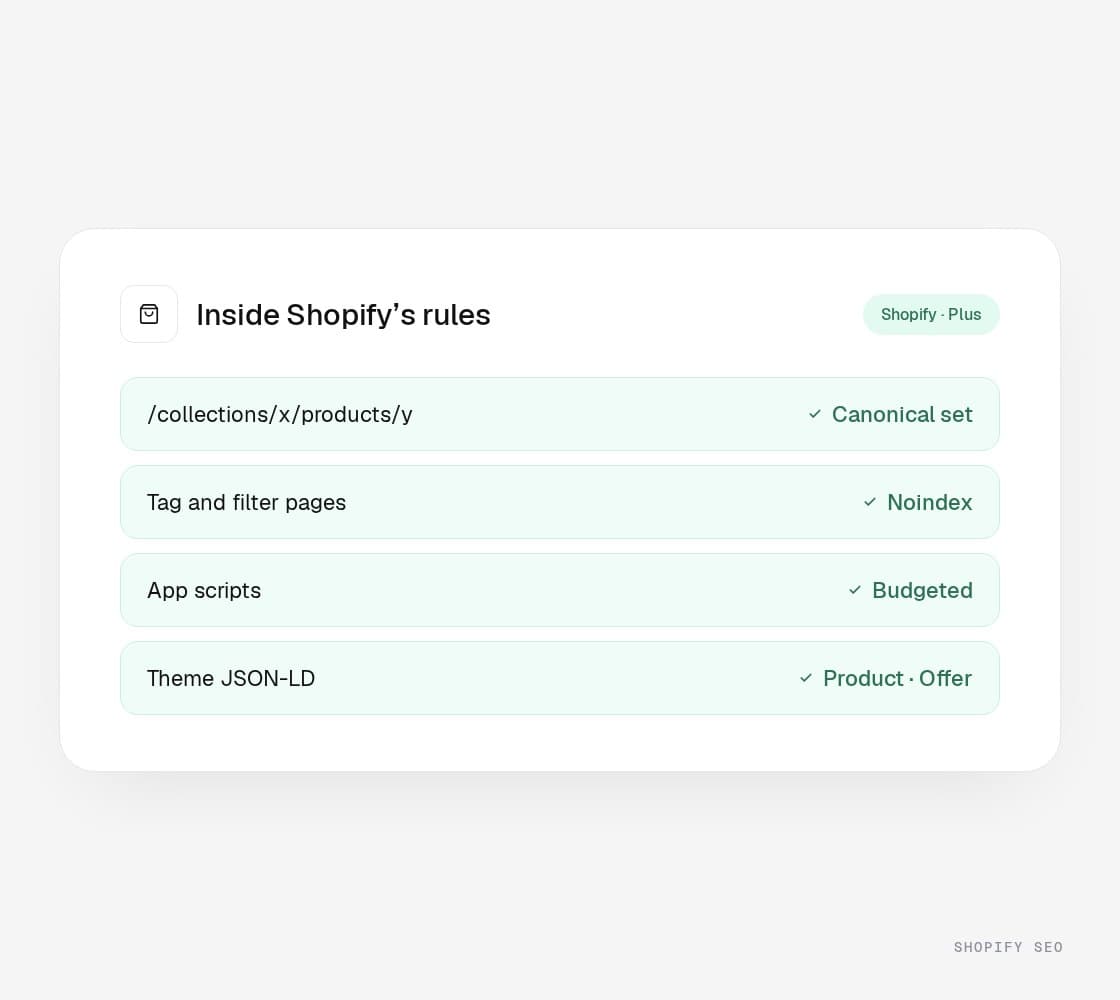
The structure Shopify gives you is fixed. What the theme does with it is not, and that is where duplicate URLs, index bloat, and lost redirects come from.
Canonical and duplicate URL handling
Tag, filter, and sort URL index rules
robots.txt.liquid and sitemap control
Redirect maps and 404 cleanup
International with Markets and hreflang
Search Console and index coverage
02 · Speed
Theme performance as SEO
Core Web Vitals feed rankings and conversion at once. On Shopify, speed is decided by the theme and by every app that loads with it.
Core Web Vitals on field data
App script audit and removal
Image sizing, formats, and lazy loading
Online Store 2.0 theme cleanup
Hydrogen or Next.js when speed is the ceiling
03 · Content
Pages that answer the query
Collection and product pages carry the rankings on a store. They need words a shopper reads and a crawler quotes, managed in a way that scales past a hundred collections.
Collection copy with Online Store 2.0 sections
Product copy with specs and FAQs
Buying guides and comparison pages
Shopify blog structure and internal links
Metafields for on-page SEO at scale
Readable by the answer engines
04 · Data
Structured data from one source
Rich results need one truthful set of markup. On a Shopify store that means deciding whether the theme or an app emits it, and switching the rest off.
Product schema with offers and availability
Review schema without duplicates
Organization and BreadcrumbList
Merchant Center feed parity
Rich results monitoring
What goes wrong
Four Shopify habits
that cost rankings. Handled.
Four Shopify habits
that cost rankings. Handled.
These show up in the first hour of almost every Shopify SEO audit we run. Each one is a change to the theme or the store settings, and each one is measurable in Search Console afterwards.
Two URLs for every product
What it costs you
Internal links point at collection-scoped product URLs that canonicalize elsewhere. Link equity leaks on every page, and crawl budget is spent twice per product.
What we do
Theme links rewritten to the canonical product URL, collection context kept in the breadcrumb instead, and canonicals verified in Search Console after the change.
Thousands of filtered URLs in the index
What it costs you
Tag and filter pages dilute the collection they belong to and eat the crawl budget the new products need to get discovered.
What we do
Index rules for tags, filters, and sort orders set in the theme and robots.txt.liquid, with the few filter pages that deserve to rank kept, given copy, and linked.
Rich results that disappeared
What it costs you
Three apps emit three Product schemas with different prices. Google stops trusting any of them, and the price and the stars leave your listing while a competitor keeps theirs.
What we do
One source of structured data in the theme, the apps set to emit nothing, and rich results watched in Search Console so a new app cannot undo it quietly.
A theme too slow to rank
What it costs you
Core Web Vitals are a ranking input and a conversion input at once. A theme carrying dozens of app scripts fails both on a phone, and the lab score hides it.
What we do
App scripts audited and cut, images sized and lazy-loaded, the theme trimmed. When that is not enough, a Hydrogen or Next.js storefront on the same Shopify backend.
Free Shopify SEO audit
Your store, read
the way Google
reads it.
the way Google
reads it.
Five business days, a senior engineer, and a document you keep: your canonical and indexing situation, the app scripts costing you speed, your structured data sources, and the collection pages worth writing for. Free, whether or not you hire us.
1. Index and canonical review
Which URLs Google has, which it should have, and where the theme is linking to the wrong version of a product.
2. App script and speed inventory
Every script the theme loads, what it costs on a phone, and which apps are earning their place on the page.
3. Structured data sources
Who emits Product, Review, and Organization markup on your pages, where they disagree, and which one should win.
4. Collection page opportunity list
The collections with real search demand and no copy, in the order the traffic justifies writing them.
5. Redirect map health
For stores that have replatformed, the URLs that were mapped, the long tail that was not, and what it is still costing.
- Timeline
- Five business days
- Price
- Free
- Who runs it
- A senior engineer and a strategist
Results
Show you the money.


DTC · Shopify Plus
2.4x
faster page loads · zero SEO loss
Replatformed an aging custom site to Shopify Plus without losing a single SKU or SEO ranking.
- View case study: Evelyn & Arthur case study

DTC · Shopify Plus
+34%
AOV
An established apparel brand replatformed to Shopify Plus without losing a single SKU or SEO ranking, and lifting average order value in the process.
Read case study
The big numbers
+30%
Avg. conversion rate lift within 12 months
+50%
Avg. order value lift
<1s
Page load speeds on the storefronts we build
+15%
Avg. revenue lift within 6 months
How it starts
Here's what happens
after you fill out the form.
after you fill out the form.
Sales keeps it short. A senior strategist and an engineer who has shipped on your platform join the first call when the question needs them.
Step 01
30-min
discovery callWhat you’re on, what hurts, what the ERP and the catalog look like. We’ll say early if the platform isn’t the problem.
Step 02
Free platform audit
Pricing logic, catalog, integrations, Core Web Vitals on real field data. Five business days. Yours to keep.
Step 03
Stay, upgrade,
or moveOne recommendation, with the cost of staying set against the cost of moving. Sometimes the answer is stay.
Step 04
Scoped
proposalScope, timeline, pricing: fixed-fee or T&M. First wins inside 30 days.
WE GOT THE WHOLE PACKAGE
There’s a lot more
to this story.
There’s a lot more
to this story.
Design, development, and digital marketing all live under one roof. The same team that builds your store also designs it and runs the paid, lifecycle, and CRO work behind it, so nothing gets lost in a handoff.
THE QUESTIONS YOU HAVE -
Get them out
of the way.
of the way.
Also on the menu
One team.
The rest of the work.
The rest of the work.
Each of these is its own page because people search for it by name. Behind the pages it is one team, so the SEO work knows what the developers shipped and the email flows know what the ads promised.
- View AI Search Optimization
AI Search Optimization
Get cited where shoppers now ask.
Learn more - View AI SEO
AI SEO
Rank for people. Get quoted by machines.
Learn more - View Generative Engine Optimization
Generative Engine Optimization
Be the source, not the summary.
Learn more - View LLM and ChatGPT Visibility
LLM and ChatGPT Visibility
Know what the engines say.
Learn more - View Ecommerce SEO
Ecommerce SEO
Organic revenue, not organic traffic.
Learn more - View Conversion Rate Optimization
Conversion Rate Optimization
More orders from the traffic you already have.
Learn more - View Paid Media
Paid Media
Spend that earns its way back.
Learn more - View Email and SMS Marketing
Email and SMS Marketing
The flows that earn while you sleep.
Learn more
Free Shopify SEO audit
Shopify store.
Ranking short?
Start here.
Ranking short?
Start here.
Already on Shopify? Five business days, a senior engineer, and a document you keep, covering canonicals, index rules, app scripts, structured data, and the collection pages worth writing for.
Moving to Shopify? The same five days scope the redirect map and the theme so the rankings arrive with you.