- Services
- Digital Marketing
- LLM and ChatGPT Visibility
See what
ChatGPT says.
ChatGPT says.
Be the answer. Not a footnote. See how ChatGPT, Perplexity and Claude describe you today, and what it takes to change it. Start with the free scan.
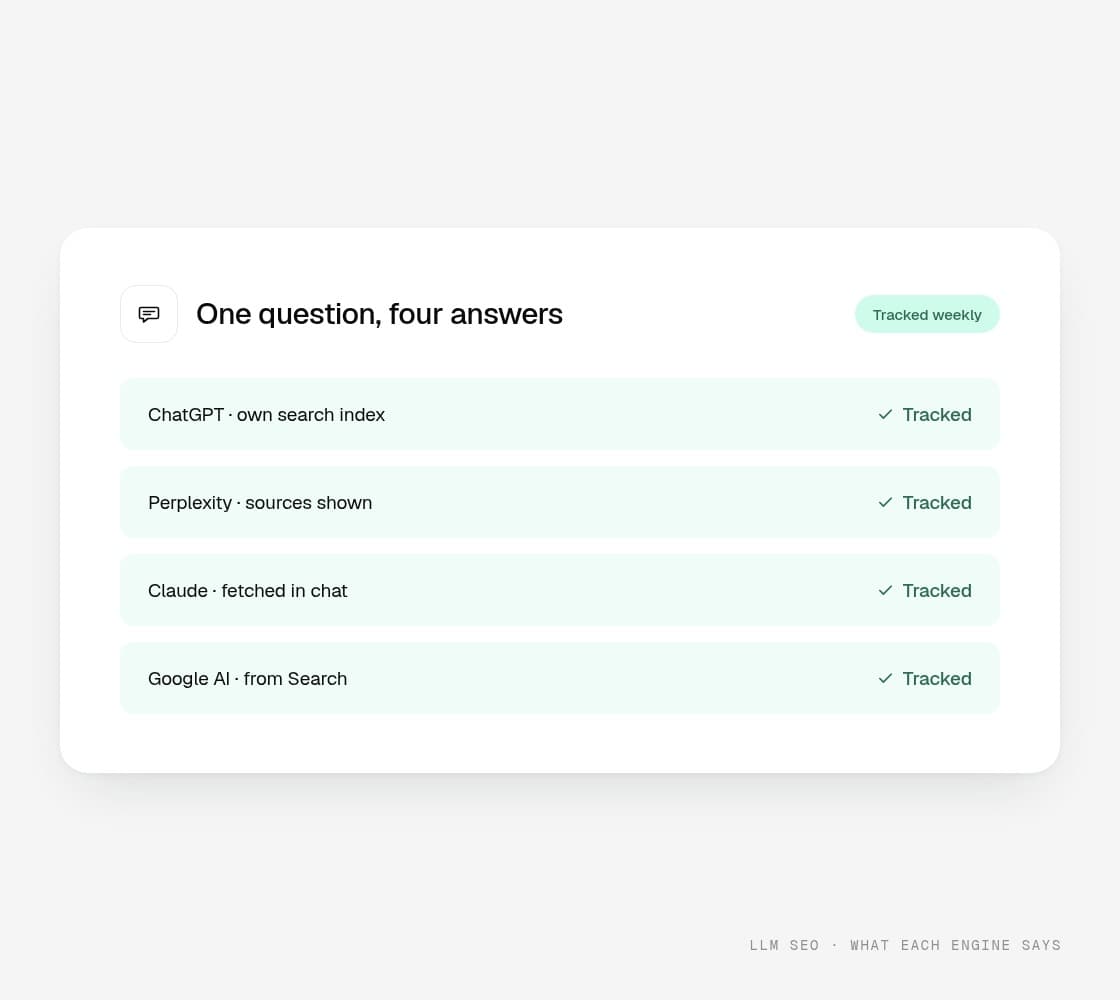







Four engines, four answers
One question.
Four different answers.
Four different answers.
The engines do not share an index, a crawler, or a taste in sources. A store can be the first citation in Perplexity and absent from ChatGPT on the same question. Six reasons the answers diverge.
Each engine runs its own crawler, and you can block one by accident
OpenAI’s OAI-SearchBot, PerplexityBot, and Anthropic’s ClaudeBot are separate agents with separate rules. A robots.txt written years ago commonly lets one through and stops another, and nothing reports it.
ChatGPT and Google reach you by different routes
AI Overviews and AI Mode are built from Google Search’s index, which Googlebot crawls, so a page that ranks can be summarised there. ChatGPT search draws on its own index. Ranking in one has no bearing on being read by the other.
Perplexity shows its sources, so the gap is visible
Answers carry a visible source list, which makes it the fastest place to see who is being cited for your category. If a reseller is sitting in that list and you are not, the reason is usually readability rather than authority.
Claude fetches on demand, and takes what it can parse
Answers are assembled from pages retrieved during the conversation. A storefront whose catalog appears only after JavaScript runs hands it a shell, and the answer gets built from whoever wrote plain HTML.
The description is wrong and nobody is watching
Models restate what the web says about a brand. Discontinued products, an old price, a positioning that has not been true for two years: all of it persists until the sources that say it are corrected.
None of it appears in any report you already read
There is no impressions chart for ChatGPT and no rank tracker for Claude. Without a prompt set run on a schedule, LLM visibility is managed on anecdote, usually whichever answer someone screenshotted last.
LLM and ChatGPT visibility
Engine
by engine.
Engine
by engine.
The shared foundation is the same for all of them: reachable, server-rendered, factual, consistent. What differs is how each engine finds you and what it rewards, so the work is set per engine and checked per engine.
01 · ChatGPT
Three agents, three jobs
OpenAI runs OAI-SearchBot for the search index, ChatGPT-User for fetches during a conversation, and GPTBot for training data. Most stores that are invisible here blocked all three with one rule and meant to block only the last.
Per-agent robots rules, decided deliberately
Server-rendered product and category pages
Agentic checkout readiness
02 · Perplexity
Sources on display
Perplexity shows the sources behind an answer, which makes it the clearest read on where you stand and the quickest to respond when a page becomes quotable.
PerplexityBot access and index health
Answer-first openings on commercial pages
Comparison and alternative pages
03 · Claude
Read during the conversation
Claude retrieves pages as the conversation needs them, so what matters most is that the page a link points at is complete and parseable the moment it is fetched.
ClaudeBot access
Facts in text rather than in tabs or images
Policies and reviews as readable content
04 · Google and Copilot
The index you already rank in
AI Overviews and AI Mode summarise from Google’s index, and Copilot draws on Bing’s. Both reward the SEO you already do, plus the structured data that makes a fact safe to restate.
Googlebot and Google-Extended set separately
Entity markup and one consistent name
Bing index health for Copilot
05 · Measurement
What each engine says, weekly
One prompt set, four engines, the same questions every run. You see citation share per engine, who is cited instead, and how each model describes the brand in its own words.
Prompt set from your buyers’ questions
Citation share and source position per engine
AI referral revenue split out in GA4
Sentiment and factual errors logged
What goes wrong
Visible in one.
Absent in three.
Visible in one.
Absent in three.
Because the engines differ, the failures differ, and a fix that works for one can leave the others exactly where they were. Four we see repeatedly.
One robots rule, three engines lost
What it costs you
A line added to keep content out of model training also removed the store from the index ChatGPT search reads, because the agents doing those two jobs are different and the rule did not distinguish them.
What we do
Access decided per agent and written down: which crawlers index, which train, which you are refusing, with the trade-off stated before sign-off.
The model describes a business you no longer run
What it costs you
An old price, a discontinued line, a positioning from two rebrands ago. It repeats because the sources still say it, and every answer that repeats it costs a sale you never saw.
What we do
Correct the sources the model leans on: your own pages first, then the profiles and listings that disagree, then measure the description until it changes.
Cited in Perplexity, invisible in ChatGPT
What it costs you
The team sees a good answer in the engine they happen to use and assumes the channel is handled, while the engine with the larger audience has never successfully read the catalog.
What we do
The same prompt set run across all four engines, so the report shows the engine you are losing rather than the one you checked.
A screenshot instead of a measurement
What it costs you
Someone pastes a good answer into Slack and it becomes the status of the channel. The next week the same prompt answers differently and nobody notices, because nothing was recorded.
What we do
A fixed prompt set on a schedule with the raw answers kept, so a change in citation share can be traced to the answer that changed.
Free tool
Scan first.
Then decide.
Then decide.
Paste your store’s address. In a few seconds you see which engines can reach it, whether the catalog is readable without JavaScript, what your structured data says about you, and what to fix first. No email needed.
1. Crawler access, engine by engine
ChatGPT, Claude, Perplexity, Google AI, Copilot, Apple, and Meta, each with the verdict robots.txt gives it.
2. Readable without JavaScript
How much of the page a crawler that does not run scripts can read, and whether the product facts are in it.
3. Entity and product schema
Organization, WebSite, Product, reviews, and policies, and whether the markup agrees with the page.
4. What to fix first
Three findings, ordered by how much each moves the score, each with its measurement.
- Takes
- About ten seconds
- Costs
- Nothing. No email.
- Reads
- Public pages only
The scan reads what any visitor’s browser receives. It does not run prompts against the engines; the citation baseline after the scan does.
Other options
A monitoring tool, a PR firm, or us.
An honest read on the alternatives. Each is good at something here.
Results
Show you the money.


DTC · SEO + CRO
+202%
traffic · month over month
A full SEO and CRO rebuild. Organic search now drives 25% of overall revenue, and AOV rose 30%.


DTC · Shopify Plus
2.4x
faster page loads · zero SEO loss
Replatformed an aging custom site to Shopify Plus without losing a single SKU or SEO ranking.
The big numbers
+30%
Avg. conversion rate lift within 12 months
+50%
Avg. order value lift
<1s
Page load speeds on the storefronts we build
+15%
Avg. revenue lift within 6 months
How it starts
Here's what happens
after you fill out the form.
after you fill out the form.
Sales keeps it short. A senior strategist and an engineer who has shipped on your platform join the first call when the question needs them.
Step 01
30-min
discovery callWhat you’re on, what hurts, what the ERP and the catalog look like. We’ll say early if the platform isn’t the problem.
Step 02
Free platform audit
Pricing logic, catalog, integrations, Core Web Vitals on real field data. Five business days. Yours to keep.
Step 03
Stay, upgrade,
or moveOne recommendation, with the cost of staying set against the cost of moving. Sometimes the answer is stay.
Step 04
Scoped
proposalScope, timeline, pricing: fixed-fee or T&M. First wins inside 30 days.
WE GOT THE WHOLE PACKAGE
There’s a lot more
to this story.
There’s a lot more
to this story.
Design, development, and digital marketing all live under one roof. The same team that builds your store also designs it and runs the paid, lifecycle, and CRO work behind it, so nothing gets lost in a handoff.
THE QUESTIONS YOU HAVE -
Get them out
of the way.
of the way.
Also on the menu
One team.
The rest of the work.
The rest of the work.
Each of these is its own page because people search for it by name. Behind the pages it is one team, so the SEO work knows what the developers shipped and the email flows know what the ads promised.
- View AI Search Optimization
AI Search Optimization
Get cited where shoppers now ask.
Learn more - View AI SEO
AI SEO
Rank for people. Get quoted by machines.
Learn more - View Generative Engine Optimization
Generative Engine Optimization
Be the source, not the summary.
Learn more - View Ecommerce SEO
Ecommerce SEO
Organic revenue, not organic traffic.
Learn more - View Shopify SEO
Shopify SEO
SEO inside Shopify’s rules.
Learn more - View Conversion Rate Optimization
Conversion Rate Optimization
More orders from the traffic you already have.
Learn more - View Paid Media
Paid Media
Spend that earns its way back.
Learn more - View Email and SMS Marketing
Email and SMS Marketing
The flows that earn while you sleep.
Learn more
Free AI visibility scan
What do they
say about you?
say about you?
Run the scan first; it takes seconds and asks for nothing. Then say what you want done about it, and a senior strategist replies within one business day with a citation baseline across ChatGPT, Perplexity, Gemini, and Claude.
Already know what you want fixed? Say so here and we will scope that instead.