- Services
- Development
- Managed Services
Launch was
the easy part.
the easy part.
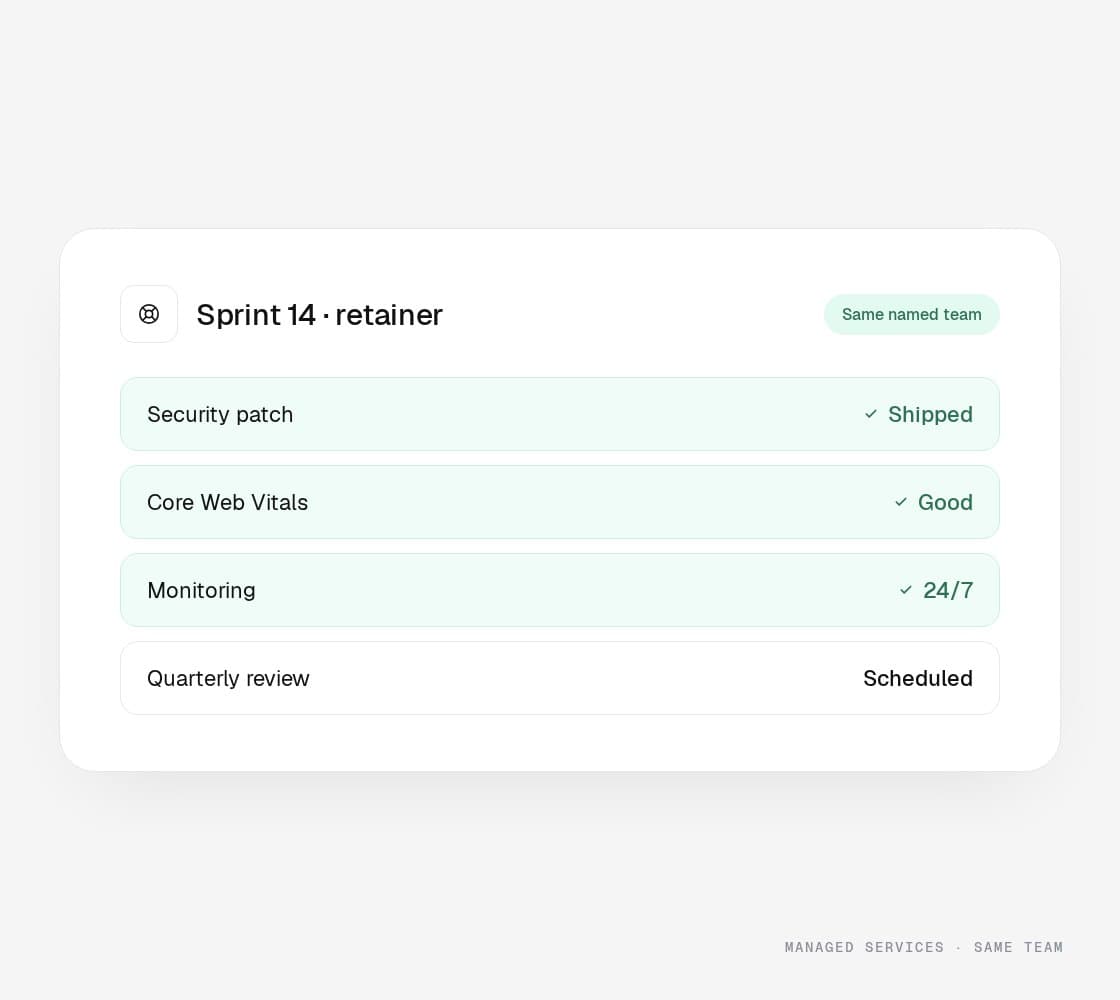
A named senior team on a monthly retainer for the years after go-live: roadmap sprints, upgrades and patching, monitoring, and the small fixes nobody schedules. About 60% of our revenue is this work, on purpose.
NOCO · accessory attach
+38%







Sound familiar?
The site is live.
The list is longer.
The list is longer.
Every store accumulates a backlog after launch: the integration that needs babysitting, the patch nobody applied, the product page change marketing asked for in March. Six signs the site needs a team rather than a ticket queue.
A patch backlog nobody owns
Security releases land on a schedule you do not control. When applying them is nobody’s job, the version drifts until an upgrade becomes a project, and a breach becomes a risk you have already accepted without deciding to.
One developer who knows where everything is
The freelancer who built the checkout customization is the only person who can touch it. When they are on vacation, the store waits. When they leave, the knowledge goes with them.
Marketing requests that take a quarter
A landing page, a product page module, a new promotion rule. Each one waits behind an infrastructure fire, so the campaign ships late or on a page builder that fights the theme.
Core Web Vitals that slid since launch
Apps got added, images got bigger, the tag manager grew. Nobody watched the field data, so the store that launched fast is now slow on a phone, and rankings followed it down.
Integrations that fail quietly
The ERP sync stops at 2 a.m. and nobody knows until orders are missing. Monitoring was a launch-day checklist item that never became a practice.
An agency that left after the invoice
The build team rolled onto the next project. Support is a shared inbox with a slow reply, and every fix needs a new statement of work before anyone looks at it.
Managed services
Named team.
Monthly cadence.
Named team.
Monthly cadence.
Sprint-based delivery against your roadmap, with the platform care underneath it handled as routine rather than as an emergency. The same engineers on the kickoff and on the roadmap a year later.
01 · Roadmap
Sprints that ship your list
The backlog you have been carrying, worked through in two-week sprints with room reserved for what marketing needs this month.
Two-week sprints against your backlog
Product, collection, and checkout improvements
Landing pages and campaign builds
Integration and middleware work
B2B, subscriptions, and loyalty features
Quarterly business reviews
02 · Care
Patching, upgrades, and versions
The unglamorous work that keeps a store supported, secure, and upgradeable, done on a calendar instead of after an incident.
Security patches on release
Version upgrades, planned not panicked
Theme and app updates
Dependency, PHP, and Node upgrades
Staging, review, and release process
03 · Watch
Monitoring and response
Every alert has a person behind it. Failures are caught by the monitor, not by a customer or a spreadsheet.
Uptime, error, and performance monitoring
Integration health checks
On-call and incident response
Core Web Vitals on field data
Hosting and infrastructure review
04 · Team
How the retainer works
A named team that joins your process rather than a vendor you file tickets with. Most of our retainer clients have an in-house team we extend, not replace.
Named senior engineers, no rotation
Your standups, your tooling
US-hours overlap from North America and Europe
DPAs, BAAs, and MSAs as standard
Knowledge transfer built in
Retainer sized to your roadmap
What goes wrong
The fires you know
by name. Handled.
The fires you know
by name. Handled.
Four failures that every store hits eventually, what each one costs while it waits, and how a retainer turns it into routine work.
The version nobody upgraded
What it costs you
An unsupported version stops receiving security patches. Every day on it is accepted risk, and the eventual jump costs more than the upgrades it skipped.
What we do
Upgrades go on the calendar the day the release notes do. Small, frequent, rehearsed on staging, with the customizations that will break listed before they break.
The integration that fails at 2 a.m.
What it costs you
Orders that never reach the ERP, inventory that lies to shoppers, and a morning spent reconciling by hand before anyone can say what happened.
What we do
Every integration gets a health check and an alert with a person behind it. The monitor catches the failure; customer service never has to.
A request that waits a quarter
What it costs you
The landing page ships after the campaign. Marketing builds around engineering instead of with it, and the storefront grows page-builder scar tissue.
What we do
A sprint cadence with room reserved for marketing work, so a product page module or a landing page is a ticket, not a negotiation.
One person who knows everything
What it costs you
When the one developer is away, the store waits. When they leave, the knowledge leaves, and the next team starts by reverse-engineering their work.
What we do
A named team, not a name. Documentation, shared repos, and paired handoff are part of the retainer, so nothing lives in one head.
Start here
Five days.
Then a plan.
Then a plan.
Before any retainer, the free five-day audit. A senior engineer and a strategist go through what the store runs on, what it is costing you, and what to fix first. You keep the document whether or not you hire us.
1. What the store runs on
Platform version, theme or codebase state, apps and extensions, integrations, and hosting, with the risks in each named.
2. What it costs to run
Licenses, apps, hosting, and the hours going into keeping it up, set against what the same store should cost.
3. Core Web Vitals on field data
How the store performs for real shoppers on real phones, not in a lab, and which fixes would move the numbers Google uses.
4. The backlog, prioritized
Everything you have been meaning to get to, ordered by risk and revenue, with the quick wins separated from the projects.
5. A retainer sized to it
Building, Scaling, or Rescuing, with the team and cadence the backlog actually needs. Real numbers, before anything is signed.
- Timeline
- Five business days
- Price
- Free
- Who runs it
- A senior engineer and a strategist
Other options
Hire, freelance, offshore, or us.
Each has a place. The question is who is awake when the ERP sync fails, and who still knows the codebase next year.
Results
Show you the money.
- View case study: Noco case study
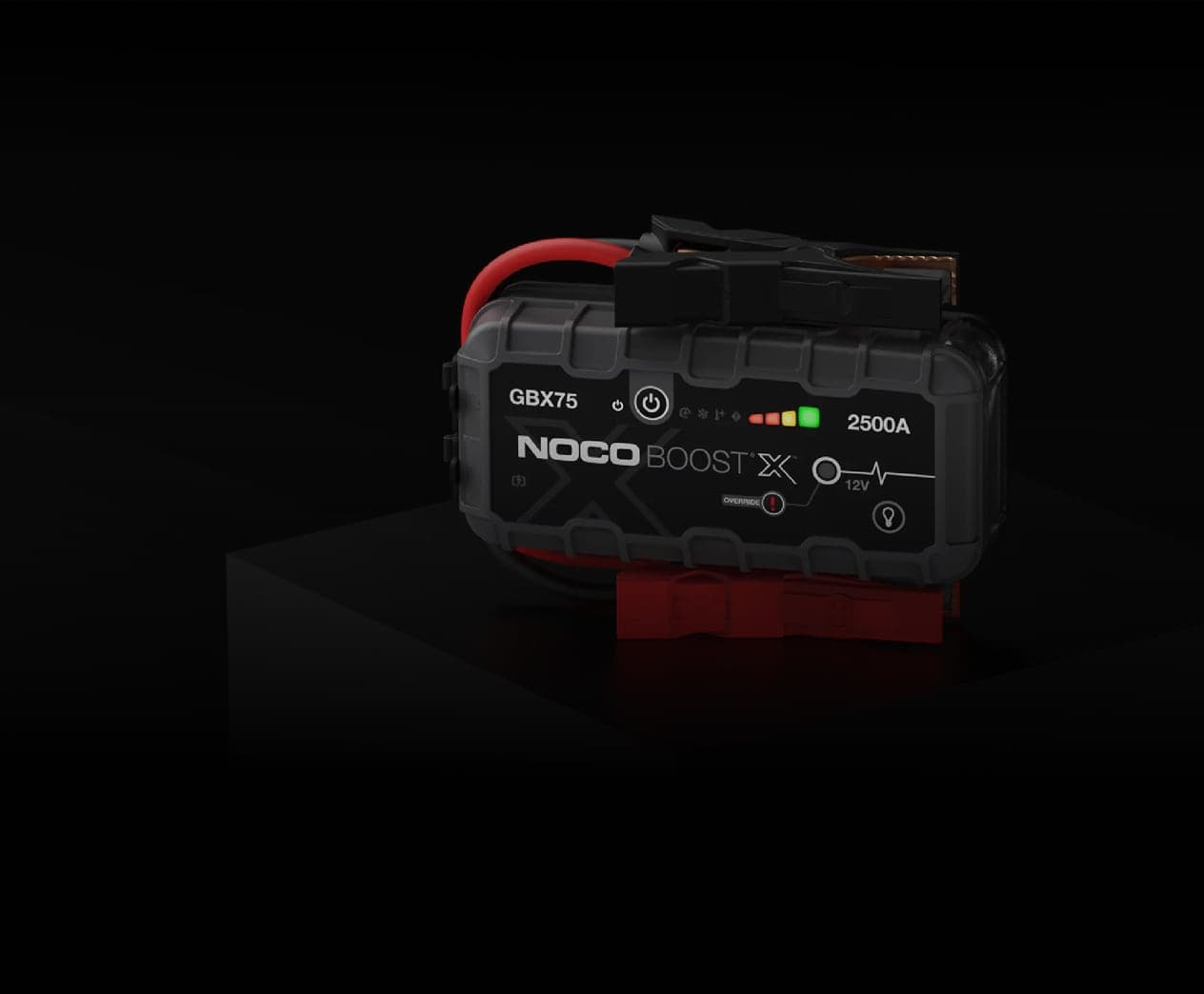
DTC + B2B · Managed services
+38%
accessory attach
A long-running managed-services partnership where every quarter ships more than the last. PDP rebuilds, accessory and replacement-parts catalog, warranty-driven lifecycle.
Read case study 

DTC · DevOps
24/7
monitoring + support
Development operations as an ongoing engagement, with monitoring and support in place around the clock.


DTC · Immediate needs
<24h
to first updates
Brought in for immediate needs on a live storefront, with the first updates shipped inside 24 hours.
The big numbers
+30%
Avg. conversion rate lift within 12 months
+50%
Avg. order value lift
<1s
Page load speeds on the storefronts we build
+15%
Avg. revenue lift within 6 months
How it starts
Audit, scope,
kickoff, sprint.
kickoff, sprint.
No onboarding decks. Discovery happens with the engineers who will do the work, and the first commit lands inside the first month.
Step 01
Free five-day
auditWhat the store runs on, what it costs, what to fix first. Five business days, a document you keep.
Step 02
Scoped
retainerBuilding, Scaling, or Rescuing, sized to the backlog the audit found. Kickoff within two weeks of a signed scope.
Step 03
Kickoff and
first commitDiscovery with the engineers who will do the work. First commit inside 30 days, in your repos, on your review process.
Step 04
Quarterly
reviewWhat shipped, what it moved, what is next. The retainer has to earn the next quarter every quarter.
WE GOT THE WHOLE PACKAGE
There’s a lot more
to this story.
There’s a lot more
to this story.
Design, development, and digital marketing all live under one roof. The same team that builds your store also designs it and runs the paid, lifecycle, and CRO work behind it, so nothing gets lost in a handoff.
THE QUESTIONS YOU HAVE -
Get them out
of the way.
of the way.
Also on the menu
One team.
The rest of the work.
The rest of the work.
Each of these is its own page because people search for it by name. Behind the pages it is one team, so the SEO work knows what the developers shipped and the email flows know what the ads promised.
- View Accessibility Audit
Accessibility Audit
WCAG 2.2, one price, a backlog you can act on.
Learn more - View Site Speed Optimization
Site Speed Optimization
Faster pages, measured in the field.
Learn more - View ERP Integration
ERP Integration
Real-time, or it is not integrated.
Learn more - View NetSuite Integration
NetSuite Integration
NetSuite and the store, in step.
Learn more - View AI Search Optimization
AI Search Optimization
Get cited where shoppers now ask.
Learn more - View AI SEO
AI SEO
Rank for people. Get quoted by machines.
Learn more - View Generative Engine Optimization
Generative Engine Optimization
Be the source, not the summary.
Learn more - View LLM and ChatGPT Visibility
LLM and ChatGPT Visibility
Know what the engines say.
Learn more
Free five-day audit
Live site.
Long list?
Start here.
Long list?
Start here.
Already live and carrying a backlog? Five business days, a senior engineer, and a document you keep, covering what the store runs on, what it is costing you, and what to fix first.
Something on fire right now? Say so in the message and the first reply is an engineer, not a scheduling link.