- Platforms
- Headless & Composable
Headless
stopped being
expensive.
stopped being
expensive.
A productized headless storefront on Next.js, connected to Shopify Plus, Adobe Commerce, or BigCommerce. Built around Core Web Vitals and the organic rankings that follow them.
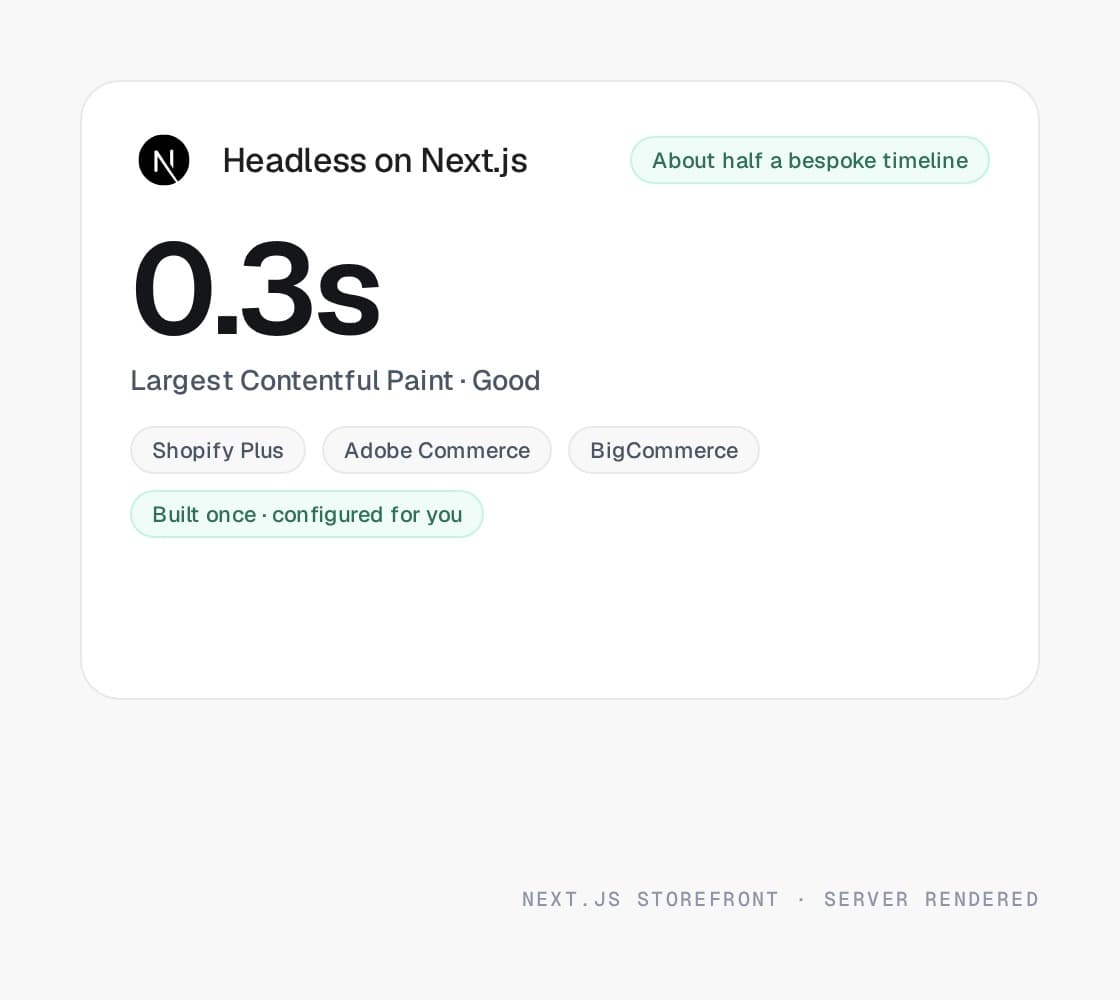
Anova, headless build
<1s







The old math
“Headless is
for enterprise.”
for enterprise.”
That was true when every headless build started with an empty repository, six months, and a budget only large brands could justify. We built the parts every storefront needs once and made them configurable, which moved the threshold. Here is what the old advice still assumes, and what has actually changed.
Then: six months and a bespoke frontend. Now: a storefront that already works
Cart, checkout handoff, search, PDP and PLP architecture, CMS integration, rendering and caching. Every headless project used to pay engineers to solve all of it again. Ours is built once, configured per brand, and the roadmap keeps improving without you paying for it twice.
Then: performance was a nice-to-have. Now: it is a ranking input
Core Web Vitals feed directly into search, and a stock theme carrying a stack of third-party app scripts cannot reach the numbers a controlled frontend can. Anova and Probulin both run under a second. The Brace Shop came up 62% on page speed.
Then: only enterprise could justify it. Now: the threshold is your model, not your size
The question stopped being how big you are and became how much organic search and conversion rate are worth to you. For most brands selling online, a page-speed advantage their competitors on stock themes cannot match is worth more than the difference in build cost.
Then: going headless meant replatforming. Now: your back office does not move
The storefront connects to Shopify Plus, Adobe Commerce, or BigCommerce through their APIs. Catalog, orders, customers, and admin stay where they are. Your team keeps the tools it knows, and the two decisions stop being bundled together.
Still true: marketing loses the theme editor
Layout changes go through a developer or through the CMS blocks we configure for you. This is the real trade and we would rather name it here than let you find it in month two. In practice it is a workflow change, not a capability loss.
Still true: the frontend needs an owner
Framework and dependency updates keep arriving whether or not anyone is watching. That is why we ship this on a retainer instead of handing over a repository, and it is the honest cost line that never goes away.
Headless capabilities
Everything your store needs.
Headless.
Everything your store needs.
Headless.
Design, development, and marketing on a decoupled storefront, from one team. Page speed is a ranking input, so the marketing case starts with the architecture.
01 · Design
A design system, not a theme
No theme means no theme constraints. The PDP, the PLP, and the content pages get designed for the catalog rather than around a template.
Design systems and component libraries, in code
PDP, PLP, and content layouts free of theme limits
Configurators and guided selling
Mobile-first, built to Core Web Vitals targets
WCAG 2.2 AA accessibility, designed in
02 · Development
Built once. Configured for you.
A productized storefront carries the architecture every build needs, so your budget goes to the parts that are actually yours.
Our Next.js storefront on Shopify Plus, Adobe Commerce, or BigCommerce
Hydrogen, Catalyst, or PWA Kit where they fit better
Server rendering, so the SEO survives the move
Core Web Vitals on real devices
Hosting, build pipelines, and preview environments
Framework and dependency upgrades, on retainer
03 · Marketing
Speed you can rank with
The fastest storefront in the category is a marketing asset. It ranks better, converts better, and makes paid landing pages cheaper.
Technical SEO on a storefront you control
Core Web Vitals as a ranking input, measured in the field
Paid landing pages that load in under a second
Email and SMS integrated with the commerce API
GA4, GTM, and PostHog instrumentation
Built by us, built for you
Meet Next.js Storefront.
Meet Next.js Storefront.
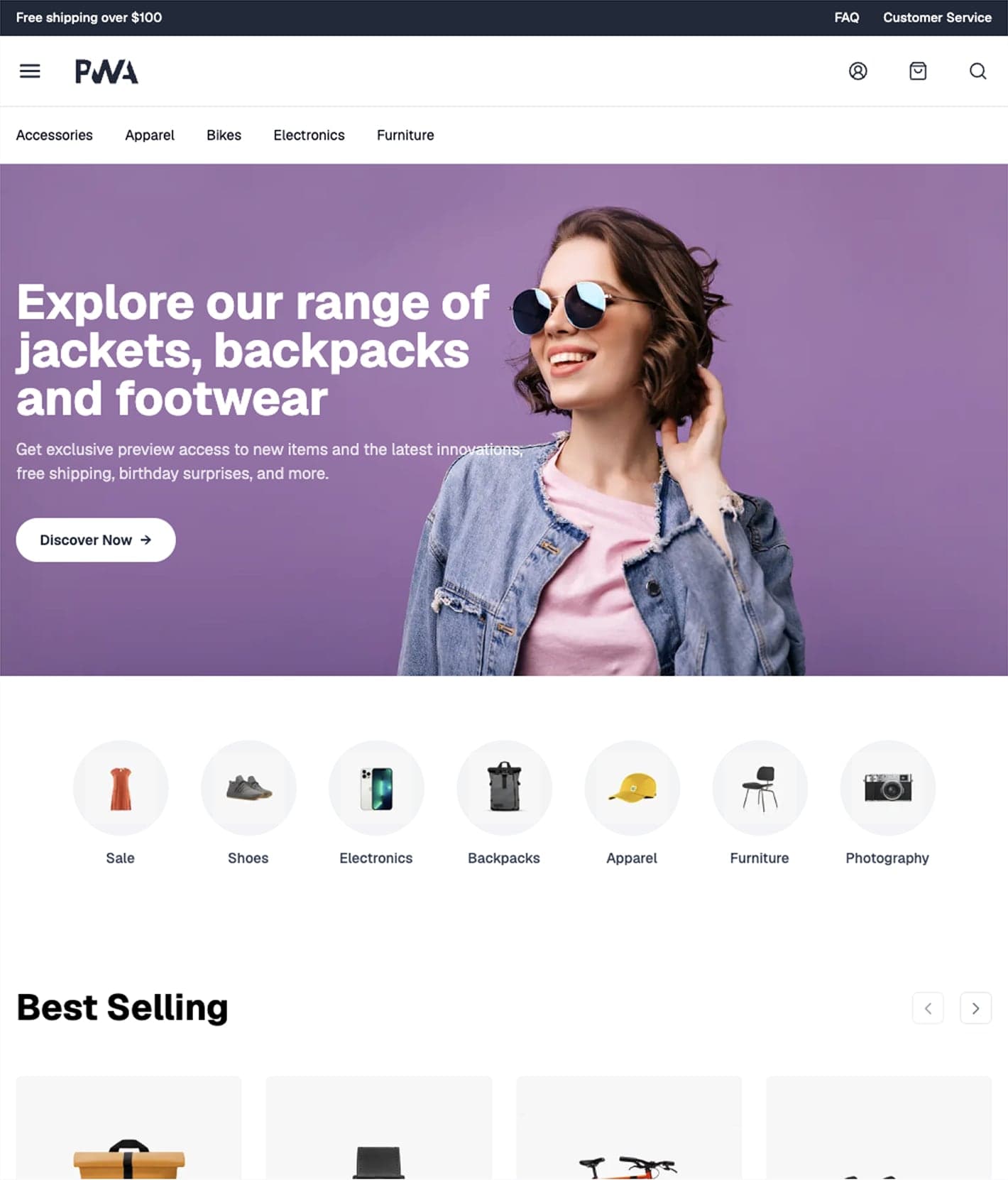
Our productized headless storefront. Connects to Shopify Plus, Adobe Commerce, or BigCommerce. Custom-build performance, not custom-build timelines.
Headless used to mean 6 months and $500k. We built the parts every storefront needs once, made them configurable, and cut the timeline in half. The roadmap keeps improving. You don't pay for it again.”
- Smart search & catalog filtering
- Streamlined checkout
- Visual CMS / page builder
- Multi-language & multi-currency
- B2B Commerce Ready
- Blazing-Fast Performance
Results
Show you the money.
- View case study: Noco case study
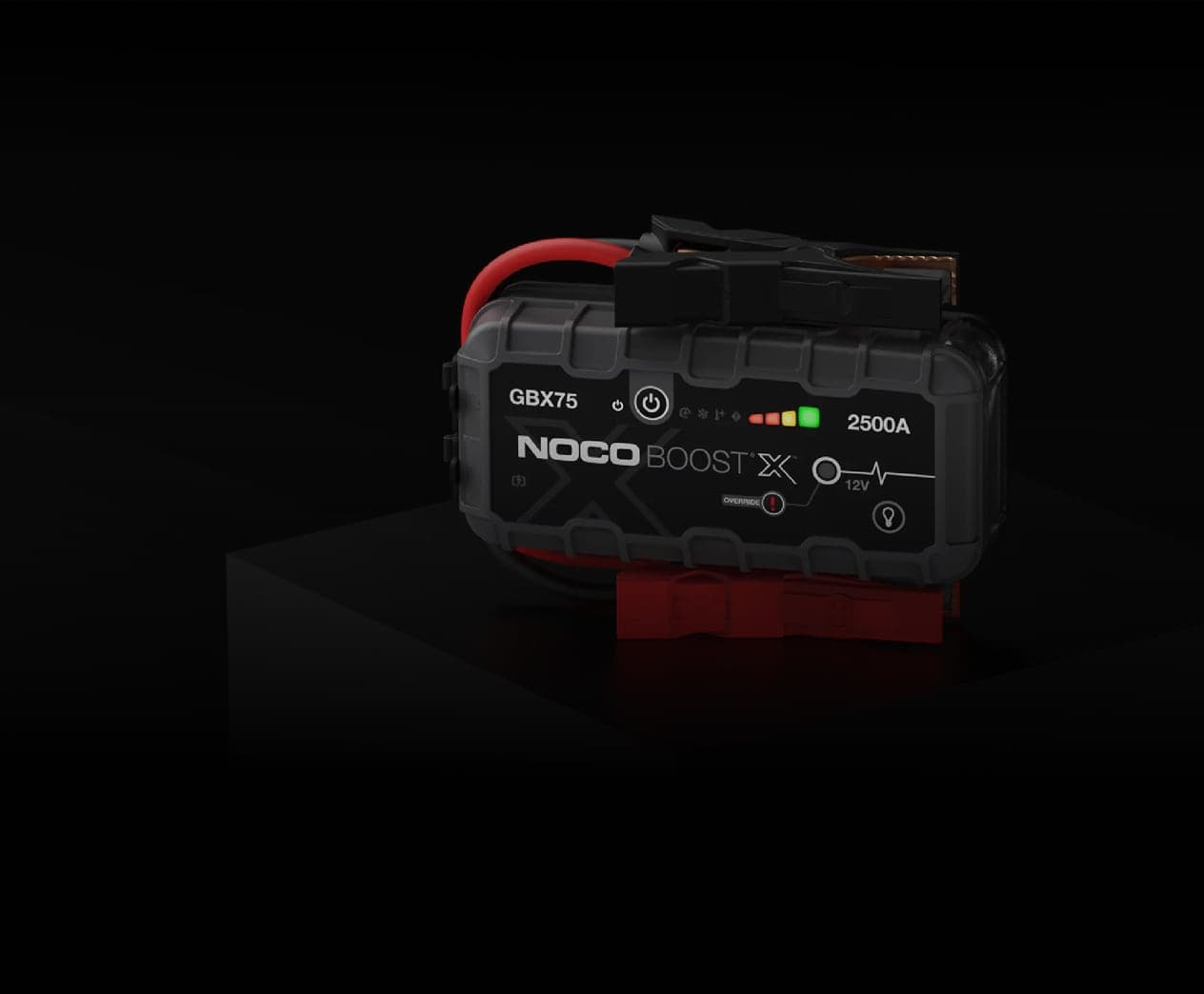
DTC + B2B · Managed services
+38%
accessory attach
A long-running managed-services partnership where every quarter ships more than the last. PDP rebuilds, accessory and replacement-parts catalog, warranty-driven lifecycle.
Read case study 

DTC · Custom build
+30%
revenue · 6 months
A shooting and outdoor retailer on a custom build, with revenue up 30% inside six months.
- View case study: Crispi case study

B2B · Adobe Commerce
+22%
revenue
Replatformed onto Adobe Commerce. Zero broken dealer integrations. The reps just noticed it got faster.
Read case study
The big numbers
+30%
Avg. conversion rate lift within 12 months
+50%
Avg. order value lift
<1s
Page load speeds on the storefronts we build
+15%
Avg. revenue lift within 6 months
Known issues
The issues you'll hit.
Handled.
The issues you'll hit.
Handled.
Headless has a specific set of failure modes, and most of them are the frontend nobody planned to own. Here is what actually goes wrong, and what we do so it doesn’t.
Marketing loses the theme editor
What it costs you
Layout changes that used to take a marketer five minutes now need a developer and a deploy, and campaigns wait on engineering.
What we do
A CMS-driven page builder with the components marketing needs, so layouts and landing pages ship without a code change.
Apps that expect a hosted storefront
What it costs you
Any app that works by injecting a script into a platform theme stops working. Reviews, upsells, and chat widgets need re-integration.
What we do
An app inventory before the build, native integrations for the ones that matter, and honest removal of the ones that were only there by habit.
SEO lost to client-side rendering
What it costs you
A storefront that renders in the browser can look empty to crawlers, and rankings fall off a cliff after launch.
What we do
Server rendering as the default, structured data emitted server-side, and crawl monitoring through the cutover.
Stale prices and inventory from caching
What it costs you
Aggressive caching makes the site fast and shows yesterday’s stock, so customers buy things you don’t have.
What we do
Cache strategy by data type: static for content, revalidated for catalog, live for stock and cart, so speed never costs accuracy.
Analytics wiring in a single-page app
What it costs you
Page views, conversions, and consent behave differently in a client-routed app, and GA4 and ad pixels quietly undercount.
What we do
GTM and server-side tagging instrumented for client routing, with consent handled properly and conversions verified end to end.
The frontend nobody maintains
What it costs you
Framework and dependency updates arrive monthly. A headless storefront with no owner degrades faster than any theme.
What we do
Ours ships on a retainer, with upgrades and monitoring scheduled, because a decoupled frontend without an owner is a liability with a countdown.
WE GOT THE WHOLE PACKAGE
There’s a lot more
to this story.
There’s a lot more
to this story.
Design, development, and digital marketing all live under one roof. The same team that builds your store also designs it and runs the paid, lifecycle, and CRO work behind it, so nothing gets lost in a handoff.
THE QUESTIONS YOU HAVE -
Get them out
of the way.
of the way.
Other platforms
Keeping
one of these?
one of these?
A headless storefront still needs a commerce backend. We build on all of these, so the platform you have is probably the one to keep.
- View Shopify
Shopify
The default for brands that would rather ship than patch.
Learn more - View Adobe Commerce
Adobe Commerce
Where catalog depth and pricing complexity still decide it.
Learn more - View BigCommerce
BigCommerce
Open SaaS, with a headless path that does not fight you.
Learn more - View Salesforce Commerce Cloud
Salesforce Commerce Cloud
The right answer when the rest of the business already runs on Salesforce.
Learn more - View Shopware
Shopware
Open source with the B2B rules engine built in, not bolted on.
Learn more
Free storefront audit
Headless now,
or next?
Start here.
or next?
Start here.
Already headless? Five business days, a senior engineer, and a document you keep, covering how the storefront renders, what it is costing you, and what to fix first.
Going headless? The same five days scope the storefront, the integrations, and a cutover that keeps your rankings.