- Platforms
- Shopware
Open source,
minus the
maintenance.
minus the
maintenance.
Shopware 6 development: Symfony and Twig storefronts, Shopware Frontends, Rule Builder and Flow Builder, B2B Components. Strong European B2B roots, and a lighter platform than Magento.







The Magento alternative nobody mentions
Rules as configuration,
not as custom modules.
not as custom modules.
Shopware 6 and Adobe Commerce are both open source PHP platforms with serious B2B capability. The difference is how much of your business logic ends up as code you have to maintain, and that difference compounds over years.
Pricing conditions that would be a custom module elsewhere
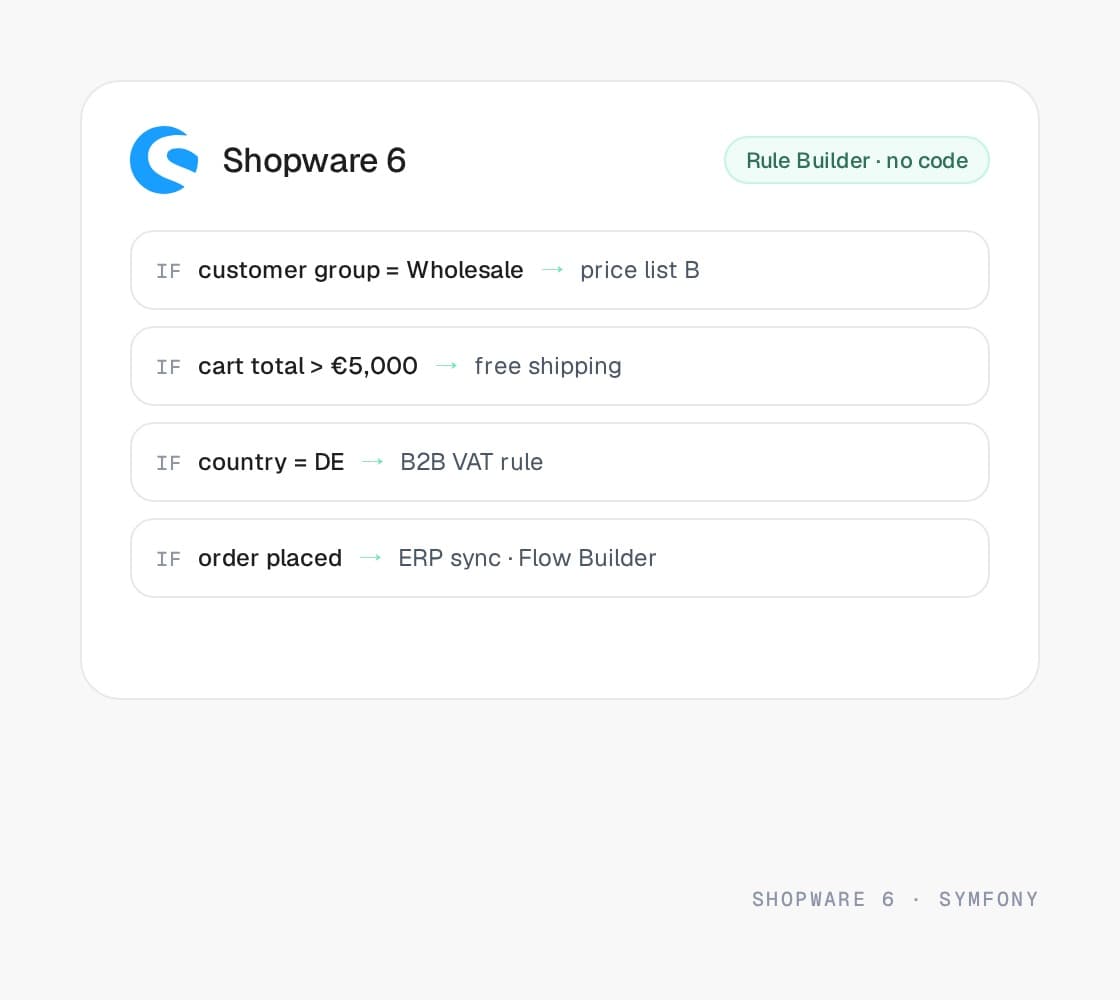
The Rule Builder handles pricing by customer group, cart value, region, or product attribute as configuration. Every one of those is a module somebody has to maintain on a platform without it.
Process automation without a queue of bespoke observers
Flow Builder covers order state transitions, notifications, and downstream triggers through the admin. It is the difference between a change request and a deployment.
A Symfony application, which matters for hiring
Shopware 6 is a standard Symfony app with a clean extension model. Any competent PHP team can read it, which is not something anyone has ever said about a heavily customized Magento 1 codebase.
B2B Components for the operation you actually run
Company accounts with employee roles and permissions, budgets, approval workflows, quote management, and quick order. Combined with the Rule Builder, it covers most of what a mid-market distributor needs.
A much smaller footprint in the United States
This is the honest counterweight. Fewer agencies, fewer developers, a smaller app ecosystem. It matters most if you expect to change partners, and it mostly disappears if you sell into Europe.
Shopware capabilities
Everything your store needs.
On Shopware.
Everything your store needs.
On Shopware.
Design, development, and marketing on Shopware 6, from one team. Shopping Experiences give marketing real control, so design is built to hand over.
01 · Design
Twig or composable, designed to hand over
Shopware’s CMS is good enough that marketing can run it. We design the system so they can.
Theme design for the Twig storefront or Shopware Frontends
Shopping Experiences layouts and content blocks
B2B buyer-portal design
Mobile-first design systems
WCAG 2.2 AA accessibility, designed in
02 · Development
Symfony underneath, rules on top
The same engineering shape as our Adobe Commerce work, on a lighter platform.
Shopware 6 builds, upgrades, and plugins
Rule Builder pricing and Flow Builder automation
B2B Components: roles, budgets, approvals
Shopware Frontends on Vue and Nuxt
ERP integration and middleware
Migrations from Magento or Shopware 5
03 · Marketing
Promotions, feeds, and search
Rule Builder is a promotions engine as much as a pricing one. The marketing team should be the one driving it.
Shopware SEO: URLs, canonicals, structured data
Google Shopping and Meta feeds
Email and SMS flows
Rule Builder promotions and campaign logic
GA4, GTM, and PostHog instrumentation
The big numbers
+30%
Avg. conversion rate lift within 12 months
+50%
Avg. order value lift
<1s
Page load speeds on the storefronts we build
+15%
Avg. revenue lift within 6 months
Known issues
The issues you'll hit.
Handled.
The issues you'll hit.
Handled.
Shopware 6 is a strong platform with a thin US footprint, and most of its issues trace back to that footprint rather than the software.
Plugins breaking on minor updates
What it costs you
Store plugins vary in quality, and a minor Shopware update can break a plugin you depend on, which turns routine updates into risk.
What we do
A curated plugin set, staging updates against your plugins before production, and replacing fragile plugins with maintained code where it matters.
US payments, tax, and shipping
What it costs you
The ecosystem is European first. US tax automation, carriers, and payment methods can be missing or immature compared with Shopify or BigCommerce.
What we do
We integrate Avalara or TaxJar, US carriers, and the payment methods your customers expect, and test them against real US edge cases.
Migrating from Shopware 5
What it costs you
Shopware 6 is a different data model and a different frontend. A 5-to-6 migration is a replatform in everything but name.
What we do
Treated as a replatform: data mapping, plugin equivalents, redirect map, and a staged cutover, not a click-through migration.
Search without Elasticsearch
What it costs you
Default database search struggles as catalogs grow, and many builds never enable Elasticsearch, so relevance and speed degrade quietly.
What we do
Elasticsearch or OpenSearch configured from the start on catalogs that need it, with relevance tuned to your product data.
Hosting you now own
What it costs you
Self-hosted means someone owns servers, updates, backups, and security. On many builds that someone turned out to be nobody.
What we do
Managed hosting and updates on a retainer, with monitoring and backups you never have to think about.
Frontend decision made by default
What it costs you
Teams drift into Shopware Frontends because it is newer, then discover they own a Vue codebase they didn’t plan to staff.
What we do
The Twig storefront unless there is a reason for composable. We make the decision explicit before the first template is touched.
WE GOT THE WHOLE PACKAGE
There’s a lot more
to this story.
There’s a lot more
to this story.
Design, development, and digital marketing all live under one roof. The same team that builds your store also designs it and runs the paid, lifecycle, and CRO work behind it, so nothing gets lost in a handoff.
THE QUESTIONS YOU HAVE -
Get them out
of the way.
of the way.
Other platforms
Coming from
one of these?
one of these?
Most moves to Shopware start on one of these. We build on all of them, so the migration plan is written by people who know both sides of it.
- View Shopify
Shopify
The default for brands that would rather ship than patch.
Learn more - View Adobe Commerce
Adobe Commerce
Where catalog depth and pricing complexity still decide it.
Learn more - View BigCommerce
BigCommerce
Open SaaS, with a headless path that does not fight you.
Learn more - View Salesforce Commerce Cloud
Salesforce Commerce Cloud
The right answer when the rest of the business already runs on Salesforce.
Learn more - View Headless & Composable
Headless & Composable
Fast enough to outrank them. Cheap enough to actually do it.
Learn more
Head to head
Free Shopware audit
Shopware now,
or next?
Start here.
or next?
Start here.
Already on Shopware? Five business days, a senior engineer, and a document you keep, covering the version and plugins you run, what they are costing you, and what to fix first.
Moving to Shopware 6? The same five days scope the build, the integrations, and a migration that keeps your rankings.