Shopware vs
Magento
Magento
Which is better, Shopware or Magento? B2B depth, upgrade weight, US talent, and cost compared, with a verdict for your business.







The short answer
Pick one.
Here's when.
Pick one.
Here's when.
Pick Shopware when
You want open source PHP commerce with less weight: rules and flows as configuration, a Symfony codebase any team can read, and B2B Components that cover a mid-market distributor.
Pick Adobe Commerce when
The very largest catalogs, the deepest B2B module, punchout, and a US ecosystem of agencies and extensions.
The tiebreaker
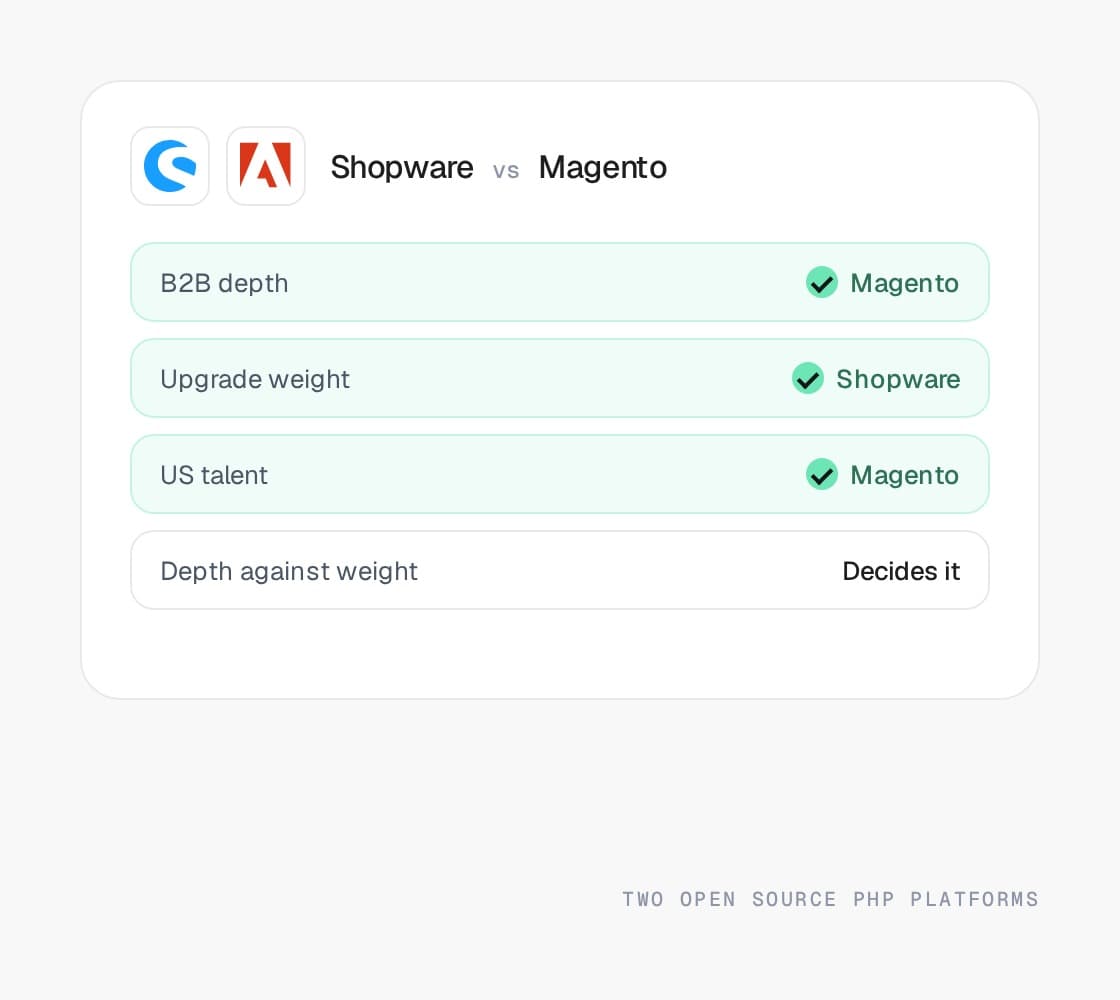
Depth against weight. If the B2B module’s depth or the US talent pool matters, Adobe Commerce. If you would trade some of that for less code to maintain, Shopware.
Row by row
Same criteria.
Both columns.
Same criteria.
Both columns.
Every comparison on this site uses the same eleven criteria, and each platform is described in the same words wherever it appears. The last column is the only opinion on the page.
Pricing model
How do you pay for the platform, and what grows with you?
Shopware
Free Community, paid editions
A free open source Community edition, and commercial editions that add B2B Components, advanced search, and support. Hosting is yours in both.
Adobe Commerce
License on revenue, or free Open Source
A license priced on revenue for Adobe Commerce, or free as Magento Open Source. Hosting, patching, and upgrades are yours either way, and they are the larger cost.
Our read
Both open source with commercial editions; Adobe Commerce’s license is priced on revenue. Both cost you hosting and a team.
Catalog and variants
How deep can the catalog go before something has to be split?
Shopware
Deep, with Elasticsearch
Deep catalogs with properties and variants, and Elasticsearch or OpenSearch for search at scale. Six-figure catalogs run well once search is configured.
Adobe Commerce
No practical ceilings
Configurable and bundle products, attribute sets, layered navigation, and six-figure catalogs are what it was built for.
Our read
Both deep. Adobe Commerce still wins on the very largest catalogs.
B2B and pricing logic
Company accounts, price lists, quotes, and where the price lives.
Shopware
B2B Components and the Rule Builder
B2B Components in the commercial editions: company accounts with roles, budgets and approvals, quotes, quick order. The Rule Builder handles pricing conditions as configuration.
Adobe Commerce
The deepest B2B module
Company hierarchies, shared catalogs, contract pricing resolved at request time, quotes, requisition lists, purchase orders, punchout.
Our read
The B2B module is deeper; B2B Components plus the Rule Builder cover most mid-market distributors with less custom code.
Checkout control
How much of checkout can you change, and who tests it?
Shopware
Plugins and the Rule Builder
Customizable through plugins, with the Rule Builder deciding payment and shipping eligibility. Yours to test on every update.
Adobe Commerce
Fully yours, including the testing
Fully customizable, and fully yours to test on every release. Extensions and years of checkout edits are the usual upgrade cost.
Our read
Both customizable and yours to test. Shopware’s Rule Builder handles eligibility without modules.
Hosting and patching
Who owns the servers, the patches, and the upgrades?
Shopware
Self-hosted Symfony app
Self-hosted or on Shopware’s cloud. A Symfony application with a clean extension model, so any competent PHP team can read it. Patches and upgrades are yours.
Adobe Commerce
Self-managed, versions have dates
Self-managed, on your hosting or Adobe’s cloud infrastructure. Versions carry support dates; patches, upgrades, and monitoring are your job or your agency’s.
Our read
Both self-managed. Shopware’s cleaner extension model usually means cheaper upgrades.
ERP and integrations
What the APIs give you, and where the middleware starts.
Shopware
Store API, App System, Flow Builder
Store API and Admin API, the App System, and Flow Builder for process automation. ERP connectors exist and skew European.
Adobe Commerce
Full APIs, queues, cron
REST and GraphQL APIs, message queues, cron, and a mature ERP connector market. Middleware for ERP pricing and inventory is normal work here.
Our read
Both have full APIs and queues. Adobe Commerce has the larger ERP connector market, especially in the US.
Apps and talent
How big the app and agency pool is, and where.
Shopware
Strong in Europe, thin in the US
Strong in German-speaking Europe and thin in the United States: fewer agencies, developers, and apps than any other platform here.
Adobe Commerce
Large, uneven, a shrinking pool
A large extension marketplace of uneven quality and a deep but shrinking pool of specialists. Fewer extensions is the best predictor of a cheap upgrade.
Our read
Adobe Commerce’s is larger and American; Shopware’s is European and thin here.
Frontend and speed
What the storefront is built with, and how fast it is by default.
Shopware
Twig, or Shopware Frontends
A Twig storefront that is not a compromise, or Shopware Frontends on Vue and Nuxt for composable builds.
Adobe Commerce
Slow on Luma, fast on Hyvä
Slow on the default Luma theme, fast on Hyvä or a headless storefront. The speed is decided by the build, not the platform.
Our read
Twig or Shopware Frontends against Hyvä or headless. Both reach fast storefronts when built well.
SEO and URLs
How much of the URL structure you control, and the platform habits to manage.
Shopware
Configurable URLs, plugin-set speed
Configurable URLs, canonicals, and structured data. The platform stays out of the way; the plugin stack decides the speed.
Adobe Commerce
URL keys, crawl budget to manage
URL keys you control, optional .html suffixes, and canonical and layered-navigation indexing to configure. Crawl budget is the scale problem.
Our read
Comparable control; both need layered navigation and facets kept out of the index.
Multi-store and international
Several brands, regions, or currencies under one admin.
Shopware
Sales channels, languages, currencies
Sales channels, languages, and currencies under one admin, built for multi-country European selling.
Adobe Commerce
Websites, stores, store views
Different catalogs, pricing, and payment rules per storefront under one admin. The strongest multi-store model here.
Our read
Both strong. Adobe Commerce’s websites and store views are the deeper model.
Who it fits
The merchant this platform is genuinely the right answer for.
Shopware
B2B open source, especially in Europe
B2B and manufacturer-led operations that want open source without Magento’s weight, especially anyone selling into Europe.
Adobe Commerce
Deep catalog, ERP pricing, procurement
Deep catalogs, per-account pricing from an ERP, procurement buyers, and multi-store rules that genuinely differ.
Our read
Deep B2B and US operations to Adobe Commerce. European or lighter-weight B2B to Shopware.
The big numbers
+30%
Avg. conversion rate lift within 12 months
+50%
Avg. order value lift
<1s
Page load speeds on the storefronts we build
+15%
Avg. revenue lift within 6 months
THE QUESTIONS YOU HAVE -
Get them out
of the way.
of the way.
Where to next
The pages behind
the verdict.
the verdict.
Each platform compared here has its own page: what it is good at, what it costs you, the issues merchants hit on it, and the work we do on it.
- View Shopware
Shopware
Open source with the B2B rules engine built in, not bolted on.
Learn more - View Adobe Commerce
Adobe Commerce
Where catalog depth and pricing complexity still decide it.
Learn more
Other comparisons
- Read the Shopify vs WooCommerce comparisonLearn more
Shopify vs WooCommerce
A hosted platform against a WordPress plugin. The store decides one way, the content site the other.
- Read the Shopify vs BigCommerce comparisonLearn more
Shopify vs BigCommerce
Two hosted platforms that convert well. One app, one fee, and the multi-storefront model usually decide it.
- Read the Shopify Plus vs Shopify comparisonPlusLearn more
Shopify Plus vs Shopify
Same storefront, different contract. Checkout, wholesale, and multiple stores are the reasons to step up.
- Read the Magento vs Shopify comparisonPlusLearn more
Magento vs Shopify
Depth against convenience. Where the price lives decides it more than anything else on the page.
- Read the BigCommerce vs Magento comparisonLearn more
BigCommerce vs Magento
Open SaaS against open source. B2B Edition carries a straightforward wholesale operation; the B2B module carries the rest.
- Read the Magento vs WooCommerce comparisonLearn more
Magento vs WooCommerce
Both open source, both yours to host. One is a commerce platform, the other is a blog with a store attached.
- Read the Salesforce Commerce Cloud vs Shopify comparisonPlusLearn more
Salesforce Commerce Cloud vs Shopify
Revenue share against a subscription. The one-estate case decides it, and it holds less often than it used to.
- Read the Shopware vs Shopify comparisonLearn more
Shopware vs Shopify
Open source against hosted. Geography and who owns the upgrades decide it.
- Read the Best ecommerce platform for B2B comparisonPlusLearn more
Best ecommerce platform for B2B
Ranked by where the price lives, how deep the catalog is, and who maintains it. The answer changes with each.
Free platform audit
Deciding?
Start here.
Start here.
Five business days, a senior engineer and a strategist, and a document you keep: what your store runs on, where the price lives, how deep the catalog is, which customizations would survive a move, and a straight recommendation.
The cost of staying is set against the cost of moving, on your numbers rather than a vendor’s. If the answer is stay put, that is what it says.