Best B2B
ecommerce
platforms.
ecommerce
platforms.
Which B2B ecommerce platform is best? Five platforms ranked on pricing logic, catalog depth, ERP integration, and upkeep.







The ranking
Deepest first.
Cheapest to run last.
Deepest first.
Cheapest to run last.
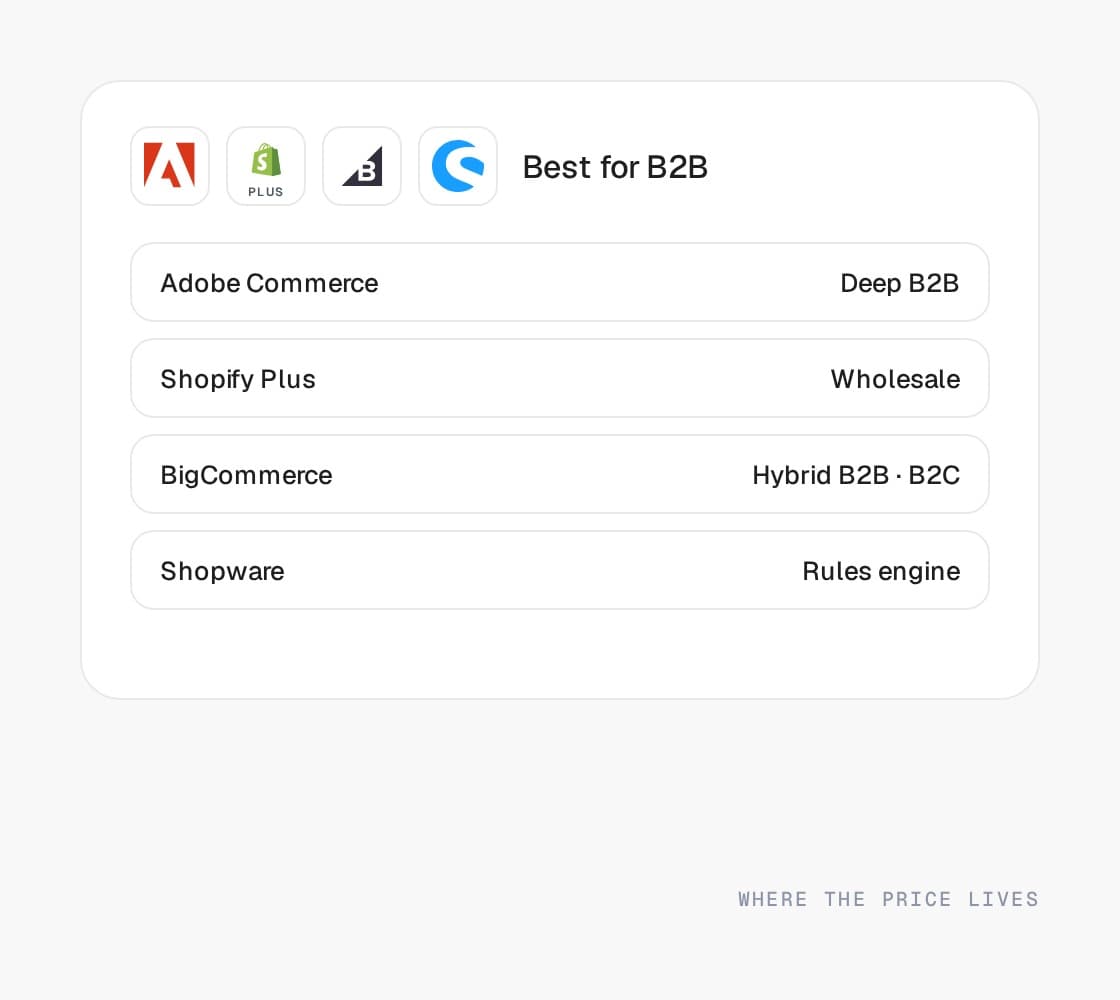
There is no best B2B platform, only the one your pricing fits. The ranking below runs from the deepest B2B engine to the one most merchants should actually buy, and the grid under it puts all five on the same criteria.
Wins when
Deep B2B. Company hierarchies, shared catalogs, contract pricing resolved live from the ERP, requisition lists, purchase orders, and punchout are the platform rather than an app. Tompkins doubled new B2B registrations on it.
The catch
You own hosting, patching, and upgrades, and the versions carry support dates. If your pricing fits in a price list, this is a tax you do not need to pay.
Wins when
Straightforward wholesale at a fraction of the running cost. Company accounts with multiple buyers, customer-specific catalogs and price lists, quantity rules, payment terms, and draft orders for rep-assisted selling, on a platform that patches itself.
The catch
Deep account hierarchies, punchout into procurement systems, and pricing that has to be fetched from the ERP on every request are where it strains.
Wins when
Hybrid B2B and B2C catalogs, no gateway fee, and multi-storefront from one catalog. B2B Edition covers company accounts and roles, price lists, quotes, quick order, and purchase orders.
The catch
B2B Edition runs as a separate app with its own portal, which shows in the buyer experience unless designed around, and it thins out at hierarchies, punchout, and live ERP pricing.
- 04
Shopware
Wins when
Layered pricing logic. The Rule Builder handles pricing by customer group, cart value, region, or attribute as configuration, and B2B Components add company accounts, roles, budgets, approvals, and quotes. Built for European multi-country selling.
The catch
A thin US footprint: fewer agencies, developers, and connectors here than in Europe, which matters most if you expect to change partners.
Wins when
The Salesforce-first enterprise, where Service Cloud, Marketing Cloud, and the CRM already run the business and commerce belongs in the same estate. B2B is Salesforce B2B Commerce, a separate product on the Lightning platform.
The catch
Priced as a share of revenue, with the smallest and most expensive talent pool on the list. Without the one-estate case, it is the wrong platform.
Same criteria
Five platforms.
One grid.
Five platforms.
One grid.
The criteria that decide a B2B platform, with each platform described in the same words it gets everywhere else on this site.
Every platform fits on this screen.
Results
Show you the money.


B2B · Magento
+100%
new B2B registrations
A complex B2B catalog with dealer pricing tiers, replatformed without breaking a single integration. New account registrations doubled.
- View case study: Crispi case study

B2B · Adobe Commerce
+22%
revenue
Replatformed onto Adobe Commerce. Zero broken dealer integrations. The reps just noticed it got faster.
Read case study - View case study: Noco case study
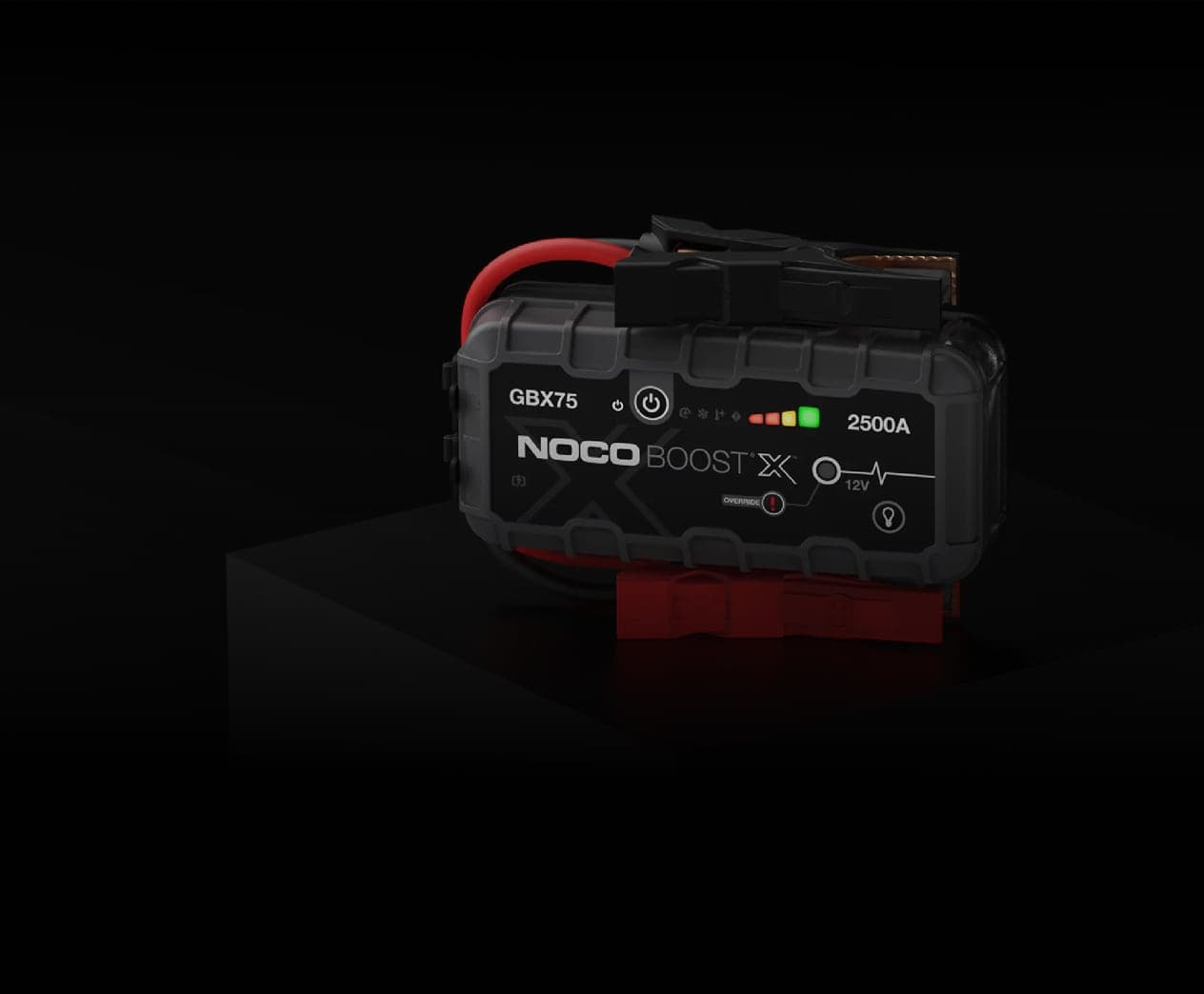
DTC + B2B · Managed services
+38%
accessory attach
A long-running managed-services partnership where every quarter ships more than the last. PDP rebuilds, accessory and replacement-parts catalog, warranty-driven lifecycle.
Read case study
The big numbers
+30%
Avg. conversion rate lift within 12 months
+50%
Avg. order value lift
<1s
Page load speeds on the storefronts we build
+15%
Avg. revenue lift within 6 months
THE QUESTIONS YOU HAVE -
Get them out
of the way.
of the way.
Where to next
The pages behind
the verdict.
the verdict.
Each platform compared here has its own page, and the move between them is written up as a plan, in the direction merchants actually make it.
- View Adobe Commerce
Adobe Commerce
Where catalog depth and pricing complexity still decide it.
Learn more - View Shopify
Shopify
The default for brands that would rather ship than patch.
Learn more - View BigCommerce
BigCommerce
Open SaaS, with a headless path that does not fight you.
Learn more - View Shopware
Shopware
Open source with the B2B rules engine built in, not bolted on.
Learn more - View Salesforce Commerce Cloud
Salesforce Commerce Cloud
The right answer when the rest of the business already runs on Salesforce.
Learn more
Migration plans
Other comparisons
- Read the Shopify vs WooCommerce comparisonLearn more
Shopify vs WooCommerce
A hosted platform against a WordPress plugin. The store decides one way, the content site the other.
- Read the Shopify vs BigCommerce comparisonLearn more
Shopify vs BigCommerce
Two hosted platforms that convert well. One app, one fee, and the multi-storefront model usually decide it.
- Read the Shopify Plus vs Shopify comparisonPlusLearn more
Shopify Plus vs Shopify
Same storefront, different contract. Checkout, wholesale, and multiple stores are the reasons to step up.
- Read the Magento vs Shopify comparisonPlusLearn more
Magento vs Shopify
Depth against convenience. Where the price lives decides it more than anything else on the page.
- Read the BigCommerce vs Magento comparisonLearn more
BigCommerce vs Magento
Open SaaS against open source. B2B Edition carries a straightforward wholesale operation; the B2B module carries the rest.
- Read the Magento vs WooCommerce comparisonLearn more
Magento vs WooCommerce
Both open source, both yours to host. One is a commerce platform, the other is a blog with a store attached.
- Read the Salesforce Commerce Cloud vs Shopify comparisonPlusLearn more
Salesforce Commerce Cloud vs Shopify
Revenue share against a subscription. The one-estate case decides it, and it holds less often than it used to.
- Read the Shopware vs Shopify comparisonLearn more
Shopware vs Shopify
Open source against hosted. Geography and who owns the upgrades decide it.
- Read the Shopware vs Magento comparisonLearn more
Shopware vs Magento
Two open source PHP platforms. Depth against weight, and which continent your buyers are on.
Free platform audit
Which B2B
platform?
Start here.
platform?
Start here.
Five business days, a senior engineer and a strategist, and a document you keep: what your store runs on, where the price lives, how deep the catalog is, which customizations would survive a move, and a straight recommendation.
The cost of staying is set against the cost of moving, on your numbers rather than a vendor’s. If the answer is stay put, that is what it says.