Shopware vs
Shopify
Shopify
Shopware or Shopify? Cost, hosting, B2B, and where your buyers are, compared with a verdict for your store.







The short answer
Pick one.
Here's when.
Pick one.
Here's when.
Pick Shopware when
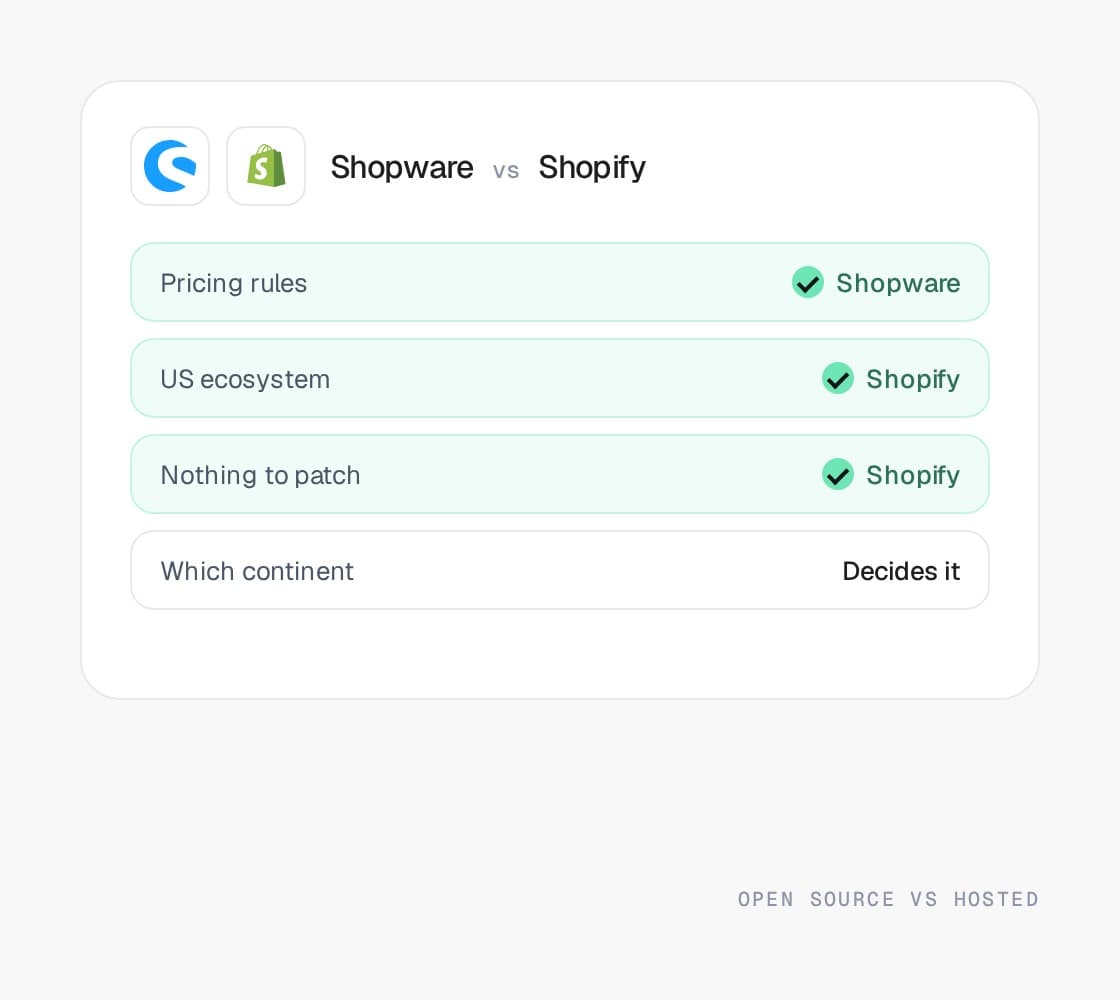
You want open source, B2B rules as configuration, and you sell into Europe or already run Shopware somewhere in the group.
Pick Shopify when
You are US-first, want the largest app and agency pool, and would rather not own hosting or upgrades.
The tiebreaker
Geography and ownership. In the United States, Shopware’s thin footprint makes Shopify the safer default unless the Rule Builder or open source is the point.
Row by row
Same criteria.
Both columns.
Same criteria.
Both columns.
Every comparison on this site uses the same eleven criteria, and each platform is described in the same words wherever it appears. The last column is the only opinion on the page.
Pricing model
How do you pay for the platform, and what grows with you?
Shopware
Free Community, paid editions
A free open source Community edition, and commercial editions that add B2B Components, advanced search, and support. Hosting is yours in both.
Shopify
Subscription plus processing
A monthly subscription by plan, plus payment processing. Using a gateway other than Shopify Payments adds a per-order platform fee.
Our read
Shopware’s Community edition is free plus hosting; commercial editions add B2B and support. Shopify is a subscription and the platform’s problem.
Catalog and variants
How deep can the catalog go before something has to be split?
Shopware
Deep, with Elasticsearch
Deep catalogs with properties and variants, and Elasticsearch or OpenSearch for search at scale. Six-figure catalogs run well once search is configured.
Shopify
Option and variant ceilings
Products, options, and variants, with ceilings on both. Deep configurables get split into duplicates or modeled with metafields and apps.
Our read
Shopware handles deeper catalogs, with Elasticsearch configured. Shopify has ceilings.
B2B and pricing logic
Company accounts, price lists, quotes, and where the price lives.
Shopware
B2B Components and the Rule Builder
B2B Components in the commercial editions: company accounts with roles, budgets and approvals, quotes, quick order. The Rule Builder handles pricing conditions as configuration.
Shopify
Not on standard plans
Wholesale runs as a password-protected storefront, an app, or draft orders until you move to Plus.
Our read
Shopware’s Rule Builder and B2B Components against B2B on Shopify (Plus). Shopware’s is the more flexible pricing engine.
Checkout control
How much of checkout can you change, and who tests it?
Shopware
Plugins and the Rule Builder
Customizable through plugins, with the Rule Builder deciding payment and shipping eligibility. Yours to test on every update.
Shopify
Branding only
Script tags and template edits are gone; anything that changes the flow needs Plus.
Our read
Shopware’s is customizable and yours to test. Shopify’s is fixed on standard and extensible on Plus.
Hosting and patching
Who owns the servers, the patches, and the upgrades?
Shopware
Self-hosted Symfony app
Self-hosted or on Shopware’s cloud. A Symfony application with a clean extension model, so any competent PHP team can read it. Patches and upgrades are yours.
Shopify
Hosted and patched for you
You own the theme and the app stack, nothing underneath.
Our read
Self-hosted against hosted. Shopware is a Symfony app any PHP team can read; it still needs one.
ERP and integrations
What the APIs give you, and where the middleware starts.
Shopware
Store API, App System, Flow Builder
Store API and Admin API, the App System, and Flow Builder for process automation. ERP connectors exist and skew European.
Shopify
Rate-limited APIs, many connectors
Admin API, GraphQL, webhooks, and a large connector market. Rate limits shape how bulk syncs have to be built.
Our read
Comparable APIs. Shopware’s connectors skew European; Shopify’s market is larger and US-first.
Apps and talent
How big the app and agency pool is, and where.
Shopware
Strong in Europe, thin in the US
Strong in German-speaking Europe and thin in the United States: fewer agencies, developers, and apps than any other platform here.
Shopify
The largest in commerce
The largest app store, agency pool, and hiring market in commerce. Most needs have an app; each one is a script and a monthly bill.
Our read
Shopify’s is enormous here. Shopware’s is strong in German-speaking Europe and thin in the US.
Frontend and speed
What the storefront is built with, and how fast it is by default.
Shopware
Twig, or Shopware Frontends
A Twig storefront that is not a compromise, or Shopware Frontends on Vue and Nuxt for composable builds.
Shopify
Liquid themes, fast by default
Liquid themes on Online Store 2.0, served from Shopify’s CDN. Fast when the theme and app scripts are disciplined; Hydrogen for headless.
Our read
Twig or Shopware Frontends against Liquid or Hydrogen. Shopify is fast by default; Shopware is fast when built well.
SEO and URLs
How much of the URL structure you control, and the platform habits to manage.
Shopware
Configurable URLs, plugin-set speed
Configurable URLs, canonicals, and structured data. The platform stays out of the way; the plugin stack decides the speed.
Shopify
Fixed paths, duplicate collections
A fixed URL structure (/products, /collections) and duplicate collection paths to canonicalize. Metadata and structured data are yours to control.
Our read
Both give reasonable control. Shopware’s URLs are configurable; Shopify’s are fixed.
Multi-store and international
Several brands, regions, or currencies under one admin.
Shopware
Sales channels, languages, currencies
Sales channels, languages, and currencies under one admin, built for multi-country European selling.
Shopify
Markets on one store
Markets handles currency and language on one store. Separate catalogs mean separate stores, synced by app or middleware.
Our read
Shopware’s sales channels and languages against Markets. Shopware was built for multi-country selling.
Who it fits
The merchant this platform is genuinely the right answer for.
Shopware
B2B open source, especially in Europe
B2B and manufacturer-led operations that want open source without Magento’s weight, especially anyone selling into Europe.
Shopify
DTC, list pricing, thousands of SKUs
DTC brands with list pricing and a catalog in the thousands that would rather ship than patch.
Our read
European or B2B-heavy open source shops to Shopware. US DTC to Shopify.
The big numbers
+30%
Avg. conversion rate lift within 12 months
+50%
Avg. order value lift
<1s
Page load speeds on the storefronts we build
+15%
Avg. revenue lift within 6 months
THE QUESTIONS YOU HAVE -
Get them out
of the way.
of the way.
Where to next
The pages behind
the verdict.
the verdict.
Each platform compared here has its own page: what it is good at, what it costs you, the issues merchants hit on it, and the work we do on it.
- View Shopware
Shopware
Open source with the B2B rules engine built in, not bolted on.
Learn more - View Shopify
Shopify
The default for brands that would rather ship than patch.
Learn more
Other comparisons
- Read the Shopify vs WooCommerce comparisonLearn more
Shopify vs WooCommerce
A hosted platform against a WordPress plugin. The store decides one way, the content site the other.
- Read the Shopify vs BigCommerce comparisonLearn more
Shopify vs BigCommerce
Two hosted platforms that convert well. One app, one fee, and the multi-storefront model usually decide it.
- Read the Shopify Plus vs Shopify comparisonPlusLearn more
Shopify Plus vs Shopify
Same storefront, different contract. Checkout, wholesale, and multiple stores are the reasons to step up.
- Read the Magento vs Shopify comparisonPlusLearn more
Magento vs Shopify
Depth against convenience. Where the price lives decides it more than anything else on the page.
- Read the BigCommerce vs Magento comparisonLearn more
BigCommerce vs Magento
Open SaaS against open source. B2B Edition carries a straightforward wholesale operation; the B2B module carries the rest.
- Read the Magento vs WooCommerce comparisonLearn more
Magento vs WooCommerce
Both open source, both yours to host. One is a commerce platform, the other is a blog with a store attached.
- Read the Salesforce Commerce Cloud vs Shopify comparisonPlusLearn more
Salesforce Commerce Cloud vs Shopify
Revenue share against a subscription. The one-estate case decides it, and it holds less often than it used to.
- Read the Shopware vs Magento comparisonLearn more
Shopware vs Magento
Two open source PHP platforms. Depth against weight, and which continent your buyers are on.
- Read the Best ecommerce platform for B2B comparisonPlusLearn more
Best ecommerce platform for B2B
Ranked by where the price lives, how deep the catalog is, and who maintains it. The answer changes with each.
Free platform audit
Deciding?
Start here.
Start here.
Five business days, a senior engineer and a strategist, and a document you keep: what your store runs on, where the price lives, how deep the catalog is, which customizations would survive a move, and a straight recommendation.
The cost of staying is set against the cost of moving, on your numbers rather than a vendor’s. If the answer is stay put, that is what it says.