Shopify vs
BigCommerce
BigCommerce
Which is better, Shopify or BigCommerce? Fees, apps, B2B, multi-storefront, and checkout compared, with a verdict for your store.







The short answer
Pick one.
Here's when.
Pick one.
Here's when.
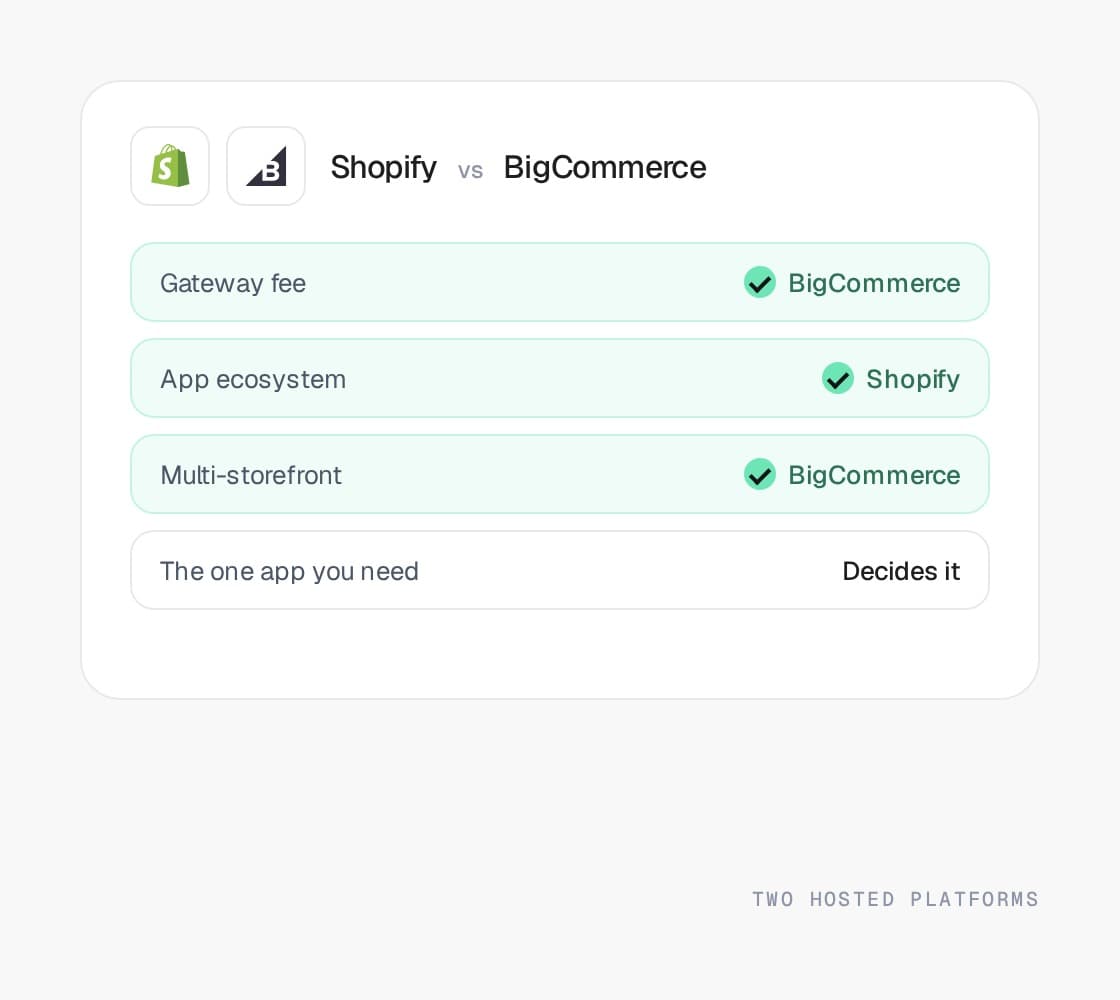
Pick Shopify when
You want the largest app store and agency pool, the checkout that converts best out of the box, and you will use Shopify Payments. Plus if checkout customization, B2B, or expansion stores are on the roadmap.
Pick BigCommerce when
You refuse to pay a platform fee on your own gateway, run several brands or regions from one catalog, or want a React storefront (Catalyst) without funding it from scratch.
The tiebreaker
Usually one app. If the tool you cannot live without exists only on Shopify, that decides it. If it exists on both, the gateway fee and the multi-storefront model decide it.
Row by row
Same criteria.
Both columns.
Same criteria.
Both columns.
Every comparison on this site uses the same eleven criteria, and each platform is described in the same words wherever it appears. The last column is the only opinion on the page.
Pricing model
How do you pay for the platform, and what grows with you?
Shopify
Subscription plus processing
A monthly subscription by plan, plus payment processing. Using a gateway other than Shopify Payments adds a per-order platform fee.
BigCommerce
Subscription, no gateway fee
A monthly subscription by plan, tiered on sales volume, with no platform fee on outside gateways and your choice of processor.
Our read
BigCommerce charges nothing extra on an outside gateway. Shopify does unless you use Shopify Payments, and at volume that is the line that decides it.
Catalog and variants
How deep can the catalog go before something has to be split?
Shopify
Option and variant ceilings
Products, options, and variants, with ceilings on both. Deep configurables get split into duplicates or modeled with metafields and apps.
BigCommerce
Higher variant cap, still a cap
A higher variant cap than Shopify, with modifiers for non-inventory choices. A configurable past the cap still gets split unless it is designed to the cap.
Our read
BigCommerce’s variant cap is higher; both split a configurable that outgrows it. Neither is Adobe Commerce.
B2B and pricing logic
Company accounts, price lists, quotes, and where the price lives.
Shopify
Not on standard plans
Wholesale runs as a password-protected storefront, an app, or draft orders until you move to Plus.
BigCommerce
B2B Edition, a separate app
Company accounts and roles, price lists, quotes, purchase orders, quick order. It runs as a separate app with its own portal; deep hierarchies and punchout get thin.
Our read
B2B on Shopify (Plus) is native and integrated. B2B Edition is capable and separate. Both stop at punchout and live ERP pricing.
Checkout control
How much of checkout can you change, and who tests it?
Shopify
Branding only
Script tags and template edits are gone; anything that changes the flow needs Plus.
BigCommerce
Fast, mostly fixed, an SDK
An optimized one-page checkout that is fast and mostly fixed. The Checkout SDK allows some customization; custom fields and complex B2B terms hit its edge.
Our read
Shopify Plus gives you Checkout Extensibility. BigCommerce gives you a fast fixed checkout and an SDK with edges. Plus wins on customization.
Hosting and patching
Who owns the servers, the patches, and the upgrades?
Shopify
Hosted and patched for you
You own the theme and the app stack, nothing underneath.
BigCommerce
Hosted and patched for you
You own the theme or the Catalyst codebase, nothing underneath.
Our read
Both hosted and patched. Owning a Catalyst frontend is the one place BigCommerce hands you a codebase.
ERP and integrations
What the APIs give you, and where the middleware starts.
Shopify
Rate-limited APIs, many connectors
Admin API, GraphQL, webhooks, and a large connector market. Rate limits shape how bulk syncs have to be built.
BigCommerce
Open APIs, per-store quotas
Open REST and GraphQL APIs with per-store quotas, webhooks, and connectors for the common ERPs and PIMs. Large catalogs sync in batches.
Our read
Comparable APIs; both have limits that shape bulk syncs. Shopify has more connectors.
Apps and talent
How big the app and agency pool is, and where.
Shopify
The largest in commerce
The largest app store, agency pool, and hiring market in commerce. Most needs have an app; each one is a script and a monthly bill.
BigCommerce
Smaller than Shopify’s
A smaller app store and agency pool than Shopify. A well-known Shopify app may be a build here.
Our read
Shopify’s is several times larger. On BigCommerce, a well-known Shopify app can become a build.
Frontend and speed
What the storefront is built with, and how fast it is by default.
Shopify
Liquid themes, fast by default
Liquid themes on Online Store 2.0, served from Shopify’s CDN. Fast when the theme and app scripts are disciplined; Hydrogen for headless.
BigCommerce
Stencil, or Catalyst on Next.js
Stencil themes, or Catalyst: a Next.js storefront framework that makes headless the shortest path on any hosted platform. Catalyst is a codebase you maintain.
Our read
Catalyst is the shortest path to a real Next.js storefront on any hosted platform. Hydrogen is Shopify’s, with more setup.
SEO and URLs
How much of the URL structure you control, and the platform habits to manage.
Shopify
Fixed paths, duplicate collections
A fixed URL structure (/products, /collections) and duplicate collection paths to canonicalize. Metadata and structured data are yours to control.
BigCommerce
Clean URLs, facets to control
Clean URLs, control of canonicals and metadata, and faceted navigation that has to be kept out of the index.
Our read
A draw on control. Shopify’s collection paths need canonicalizing; BigCommerce’s facets need keeping out of the index.
Multi-store and international
Several brands, regions, or currencies under one admin.
Shopify
Markets on one store
Markets handles currency and language on one store. Separate catalogs mean separate stores, synced by app or middleware.
BigCommerce
Multi-storefront, one catalog
Multi-storefront from one catalog is native, so brands and regions share products without syncing copies.
Our read
BigCommerce shares one catalog across storefronts natively. Shopify uses Markets for regions and separate stores for separate catalogs.
Who it fits
The merchant this platform is genuinely the right answer for.
Shopify
DTC, list pricing, thousands of SKUs
DTC brands with list pricing and a catalog in the thousands that would rather ship than patch.
BigCommerce
Fee-sensitive, multi-brand, hybrid B2B
Merchants who want hosted operations without a gateway fee and expect to outgrow a theme, and hybrid B2B and B2C catalogs.
Our read
DTC with a big app appetite to Shopify. Fee-sensitive, multi-brand, or headless-curious merchants to BigCommerce.
The big numbers
+30%
Avg. conversion rate lift within 12 months
+50%
Avg. order value lift
<1s
Page load speeds on the storefronts we build
+15%
Avg. revenue lift within 6 months
THE QUESTIONS YOU HAVE -
Get them out
of the way.
of the way.
Where to next
The pages behind
the verdict.
the verdict.
Each platform compared here has its own page: what it is good at, what it costs you, the issues merchants hit on it, and the work we do on it.
- View Shopify
Shopify
The default for brands that would rather ship than patch.
Learn more - View BigCommerce
BigCommerce
Open SaaS, with a headless path that does not fight you.
Learn more
Other comparisons
- Read the Shopify vs WooCommerce comparisonLearn more
Shopify vs WooCommerce
A hosted platform against a WordPress plugin. The store decides one way, the content site the other.
- Read the Shopify Plus vs Shopify comparisonPlusLearn more
Shopify Plus vs Shopify
Same storefront, different contract. Checkout, wholesale, and multiple stores are the reasons to step up.
- Read the Magento vs Shopify comparisonPlusLearn more
Magento vs Shopify
Depth against convenience. Where the price lives decides it more than anything else on the page.
- Read the BigCommerce vs Magento comparisonLearn more
BigCommerce vs Magento
Open SaaS against open source. B2B Edition carries a straightforward wholesale operation; the B2B module carries the rest.
- Read the Magento vs WooCommerce comparisonLearn more
Magento vs WooCommerce
Both open source, both yours to host. One is a commerce platform, the other is a blog with a store attached.
- Read the Salesforce Commerce Cloud vs Shopify comparisonPlusLearn more
Salesforce Commerce Cloud vs Shopify
Revenue share against a subscription. The one-estate case decides it, and it holds less often than it used to.
- Read the Shopware vs Shopify comparisonLearn more
Shopware vs Shopify
Open source against hosted. Geography and who owns the upgrades decide it.
- Read the Shopware vs Magento comparisonLearn more
Shopware vs Magento
Two open source PHP platforms. Depth against weight, and which continent your buyers are on.
- Read the Best ecommerce platform for B2B comparisonPlusLearn more
Best ecommerce platform for B2B
Ranked by where the price lives, how deep the catalog is, and who maintains it. The answer changes with each.
Free platform audit
Deciding?
Start here.
Start here.
Five business days, a senior engineer and a strategist, and a document you keep: what your store runs on, where the price lives, how deep the catalog is, which customizations would survive a move, and a straight recommendation.
The cost of staying is set against the cost of moving, on your numbers rather than a vendor’s. If the answer is stay put, that is what it says.