- Platforms
- Migrations
- Magento to Shopify
Off Magento.
Rankings kept.
Rankings kept.
Magento and Adobe Commerce to Shopify Plus, with every URL redirected, order history carried across, and the ERP reconnected before the date is set. We have shipped on both sides of this move.
Anthony’s Shopify Plus replatform
2.4x faster







Why merchants make this move
“The upgrade quote
came back in months.”
came back in months.”
Nobody leaves Magento because the storefront is bad. They leave when the next upgrade is quoted like a rebuild, the version has a support date attached, and the catalog turned out simpler than the platform was built for.
A version that has already left extended support
Adobe Commerce 2.4.4 left extended support on April 14, 2026, and 2.4.5 followed on August 11. If you are on either, you are running without security patches today. That changes the question from whether to move to what you do this quarter.
An upgrade quoted in months because of forty extensions
Third-party modules, hand-patched and undocumented, are why a 2.4.x upgrade gets quoted like a rebuild. When the quote for staying looks like the quote for moving, the move starts to win.
Hosting, patching, and a retainer, all for a catalog that would fit in Shopify Plus
Self-hosting buys you ceilings you may never reach. If your pricing fits in price lists and tiers and your catalog is in the thousands, you are paying Adobe Commerce prices for a Shopify problem.
A checkout the team is afraid to touch
Years of checkout customizations nobody dares upgrade, against a Shopify checkout that converts out of the box and takes upgrade-safe extensions on Plus.
A Luma frontend nobody has made fast
Hyvä fixes this without leaving the platform, and we build Hyvä frontends. If speed is the only complaint, that is the cheaper answer, and the audit will say so.
An agency that built it and stopped answering
Inheriting a Magento build is normal work for us, on Magento or on the way off it. The first deliverable is an honest picture of what you have, which is often the thing nobody wrote down.
Where your version stands
Every 2.4 release
has a date.
Every 2.4 release
has a date.
Adobe publishes the dates. Most merchants have never looked them up. Past the last date on your row, no more patches arrive, and the decision to stay or move has already been made for you. The dates are for Adobe Commerce; Magento Open Source ships the same releases with no extended year behind them.
| Version | Released | Standard support ends | Extended support ends | Status today |
|---|---|---|---|---|
| 2.4.9 | May 12, 2026 | May 31, 2029 | Not yet set | Supported |
| 2.4.8 | Apr 8, 2025 | May 31, 2028 | Not yet set | Supported |
| 2.4.7 | Apr 9, 2024 | May 31, 2027 | May 31, 2028 | Supported |
| 2.4.6 | Mar 14, 2023 | Aug 11, 2026 | Aug 31, 2027 | Extended support |
| 2.4.5 | Aug 9, 2022 | Aug 12, 2025 | Aug 11, 2026 | Unsupported |
| 2.4.4 | Apr 12, 2022 | Apr 12, 2025 | Apr 14, 2026 | Unsupported |
On Adobe Commerce Cloud the dates carry a second deadline. Adobe stops maintaining Cloud environments on unsupported versions from Jun 1, 2027, enforced for 2.4.4 and 2.4.5 on that date and for 2.4.6 and 2.4.7 from Jun 1, 2028.
Source · Adobe lifecycle policyWhat moves, what changes
What carries over.
What gets rebuilt.
What carries over.
What gets rebuilt.
Magento gave you a data model with no ceilings and URLs you could shape. Shopify gives you a fixed structure that never needs patching. Here is where each Magento concept lands, and what has to be decided rather than imported.
On Magento
Configurable products with many attributes
On Shopify
Products with options and variants, plus metafields
How it moves
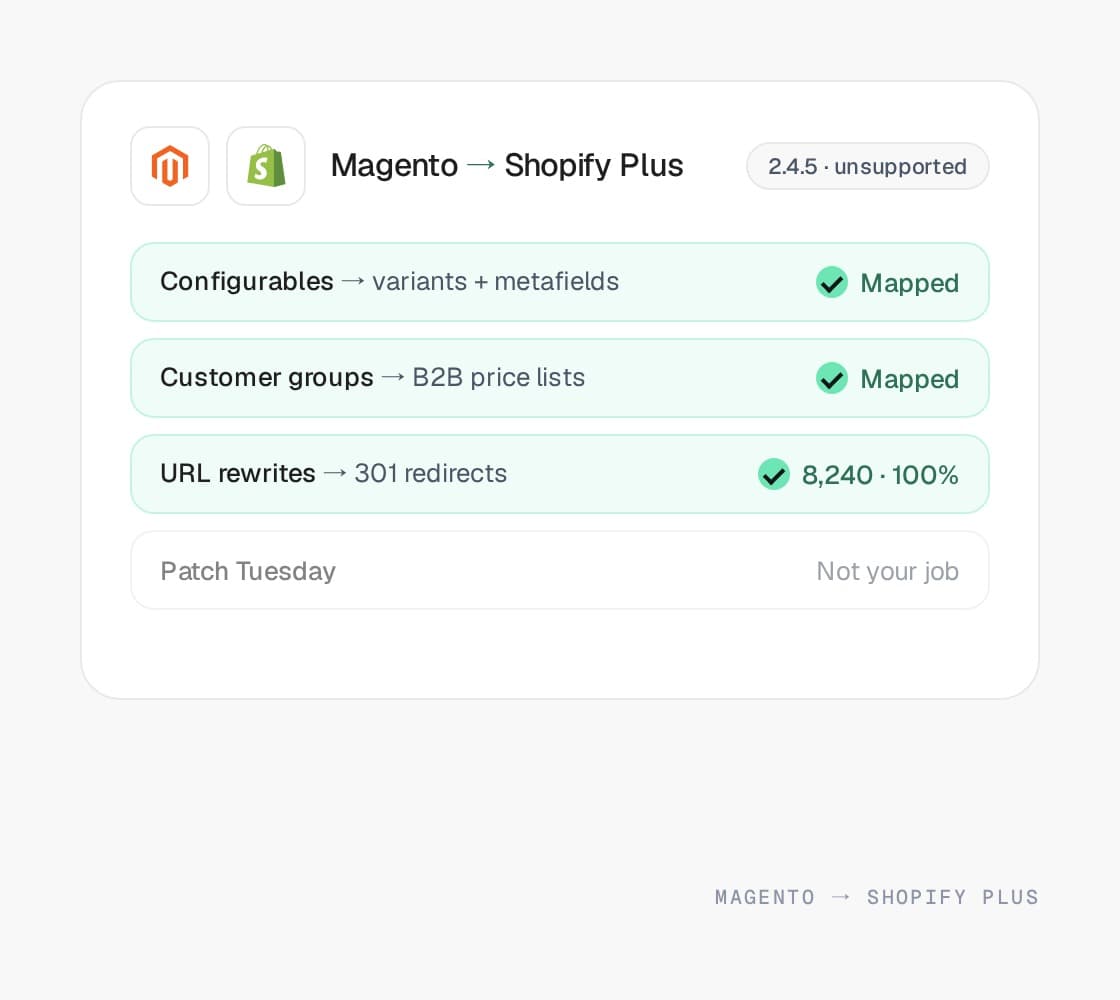
Shopify has option and variant ceilings that Magento does not. We model each configurable before import so it lands as one product, a bundle, or a metafield-driven configurator, not as five duplicates.
On Magento
Categories and layered navigation
On Shopify
Collections, with filters from Search & Discovery
How it moves
Anchor categories become automated collections. Layered-navigation facets become filters on product options and metafields, so the browse paths your buyers use still exist.
On Magento
Customer groups and tier pricing
On Shopify
B2B on Shopify company accounts, catalogs, and price lists (Plus)
How it moves
Groups map to companies and catalogs. Tier and volume breaks map to price lists and quantity rules. Contract pricing resolved from an ERP is the case we scope hardest, because it decides whether this move works at all.
On Magento
CMS pages and blocks
On Shopify
Pages, theme sections, and metaobjects
How it moves
Marketing keeps an editor. Pages move as pages, and reusable blocks become theme sections or metaobjects, so a layout change is not a developer ticket.
On Magento
URL rewrites and .html paths
On Shopify
Shopify’s fixed paths, with a 301 for every old URL
How it moves
Magento lets you shape URLs and Shopify does not. Every product, category, and CMS URL gets a redirect, canonicals point at one URL per product, and we watch the crawl through the switch.
On Magento
Cart price rules and coupons
On Shopify
Discounts, with Shopify Functions for what native rules miss
How it moves
Most rules map to native discounts. Buy X get Y across categories, tiered stacks, and customer-group-only offers become Functions on Plus rather than workarounds.
On Magento
Order and customer history
On Shopify
Imported orders and customers, sign-in without a reset
How it moves
Order history is imported so support can look up a 2019 order on day one. Customers come across with their history, and with Shopify’s customer accounts nobody resets a password.
On Magento
ERP, PIM, and 3PL integrations
On Shopify
Middleware against the Admin API, bulk operations, and webhooks
How it moves
The integration surface sets the timeline, so it is scoped first. Inventory, customer-specific pricing, and two-way order sync are rebuilt as middleware we own, with rate limits designed in rather than discovered.
On Magento
Multi-store and multi-website
On Shopify
Expansion stores and Markets (Plus)
How it moves
Storefronts that differ only by currency and language become Markets. Storefronts with different catalogs or pricing become expansion stores. Which is which is a scoping call, not a default.
On Magento
OpenSearch and Elasticsearch
On Shopify
Search & Discovery, or Algolia or Klevu
How it moves
Part-number search and synonyms do not come free on either platform. We configure search for how your buyers actually query, and keep the zero-result report.
How the move runs
Six phases.
One cutover.
Six phases.
One cutover.
The same six phases whether you are leaving Magento or anything else. The dates change with your integration surface. The order does not.
Phase 01
Scope
Integration surface, catalog shape, URL inventory, and which customizations survive the move. Five business days, a senior engineer and a strategist.
You get
A dated plan and a real number, whether or not you hire us.
Phase 02
Map
Every product type, customer group, promotion, and content block gets a destination before anything is built.
You get
The gaps as decisions, not as surprises after launch.
Phase 03
Build
The storefront, the integrations as middleware we own, and the checkout logic as extensions and Functions. Design and marketing in the same room.
You get
A store you can test against your real data.
Phase 04
Rehearse
A full import against a copy of the new store. Redirects tested URL by URL, integrations run end to end, the cutover runbook timed.
You get
A cutover nobody is nervous about.
Phase 05
Cut over
Orders frozen for minutes, DNS switched, redirects live, integrations repointed in sequence, and the day’s orders reconciled.
You get
Trading on the new platform the same day.
Phase 06
Watch
Crawl, rankings, Core Web Vitals in the field, and the integration logs for thirty days after launch.
You get
Then the retainer that keeps shipping.
What breaks
What breaks in this move.
Handled.
What breaks in this move.
Handled.
Every Magento to Shopify move hits the same handful of problems. None of them is a reason not to go. All of them are reasons to plan the data model and the redirect map before the date.
Variant ceilings splitting your configurables
What it costs you
A configurable with more options than Shopify allows gets imported as several products, so inventory, reviews, and rankings split with it.
What we do
Every configurable is modeled before import: options and variants where they fit, bundles or metafield configurators where they do not.
Redirects that miss the long tail
What it costs you
The top hundred URLs get redirected and the other thousands return a 404, and the ranking loss shows up a month after launch when nobody is looking.
What we do
Every indexed URL, from analytics, the sitemap, and Search Console, mapped and redirected, then crawled through cutover to catch what moved.
Order history left behind
What it costs you
Support cannot look up a 2019 order, warranty claims stall, and the customers with the most history are the first to feel it.
What we do
Orders and customers imported with their history, so day one on Shopify has the same past behind it as the last day on Magento.
Customer-specific pricing that stops matching the ERP
What it costs you
Magento customer groups carried the pricing logic. Rebuilt loosely on Shopify, buyers see list price and the reps hear about it first.
What we do
Groups become companies and price lists on B2B on Shopify, the ERP feed is rebuilt as middleware, and account pricing is verified before cutover.
Checkout rules with no home
What it costs you
Free-gift, tiered, and customer-group-only rules from cart price rules do not exist as native Shopify discounts, and get dropped quietly.
What we do
Each rule is classified before the build. A native discount where it fits, a Shopify Function on Plus where it does not, and a decision on what to retire.
Cutover on a live store
What it costs you
A big-bang switch with the ERP still pointed at Magento means orders land in two places, or nowhere, for the hours it takes to notice.
What we do
A rehearsed cutover: a full import against a copy first, orders frozen for minutes, integrations repointed in sequence, and reconciliation the same day.
Your options, honestly
Stay, upgrade,
or move.
Stay, upgrade,
or move.
Four real answers for a merchant on an aging Magento version. We build on Adobe Commerce, Magento Open Source, and Shopify Plus, so the recommendation is about your store, not our roster.
Upgrade in place, with Hyvä
Fits when
Deep catalog, per-account pricing from the ERP, punchout, or multi-store rules that genuinely differ. The platform is still the right one; the version is not.
The catch
You keep owning hosting, patches, and the next upgrade. The extension audit is most of the cost.
Adobe Commerce as a Cloud Service
Fits when
You want Adobe running the infrastructure and the upgrades, and your customizations can be rebuilt out of process.
The catch
Less control than self-hosting, a migration of its own for the customizations, and a licensing conversation with Adobe.
Magento Open Source or Mage-OS
Fits when
You need the platform and not the Adobe features, and you have a team that can own it. The community keeps the releases coming.
The catch
No B2B module, no Adobe support, and the same hosting and upgrade burden with a smaller vendor behind it.
Shopify Plus
Fits when
Pricing fits in price lists and tiers, the catalog is in the thousands or tens of thousands, and you would rather never patch again.
The catch
Variant ceilings, a fixed URL structure, checkout you customize through extensions, and fees on outside gateways. All handled, none free.
Results
Show you the money.


DTC · Shopify Plus
2.4x
faster page loads · zero SEO loss
Replatformed an aging custom site to Shopify Plus without losing a single SKU or SEO ranking.
- View case study: Evelyn & Arthur case study

DTC · Shopify Plus
+34%
AOV
An established apparel brand replatformed to Shopify Plus without losing a single SKU or SEO ranking, and lifting average order value in the process.
Read case study - View case study: OluKai case study

DTC · Magento
+31%
conversion
Migrated from Magento 1 to Magento 2, with fit guidance, width logic, and a PDP rebuilt around the size question. The Magento side of a move, from the inside.
Read case study
The big numbers
+30%
Avg. conversion rate lift within 12 months
+50%
Avg. order value lift
<1s
Page load speeds on the storefronts we build
+15%
Avg. revenue lift within 6 months
THE QUESTIONS YOU HAVE -
Get them out
of the way.
of the way.
Both sides of this move
Know Magento.
Know Shopify.
Know Shopify.
The Adobe Commerce page covers what you are leaving, the Shopify page covers where you are going, and the same team wrote both.
- View Adobe Commerce
Adobe Commerce
Where catalog depth and pricing complexity still decide it.
Learn more - View Shopify
Shopify
The default for brands that would rather ship than patch.
Learn more
Not decided yet? Read the Magento vs Shopify comparison.
Other migration plans
- View the WooCommerce to Shopify migration planLearn more
WooCommerce to Shopify
Stop hosting, patching, and stacking plugins. Keep the content, the customers, and the rankings.
- View the Salesforce Commerce Cloud to Shopify migration planLearn more
Commerce Cloud to Shopify
For when the one-estate case stopped holding and the revenue share did not. Service Cloud stays connected.
- View the Moving to Adobe Commerce migration planLearn more
Moving to Adobe Commerce
For the catalog, the pricing, or the buyers a hosted platform cannot carry, and for Magento 1 stores out of road.
Free migration scope
Leaving
Magento?
Start here.
Magento?
Start here.
Decided to move? Five business days, a senior engineer, and a document you keep, covering what carries over, what gets rebuilt, the redirect map, and a dated plan with a real number.
Not sure yet? The same five days compare upgrading in place against moving, with the cost of staying set against the cost of leaving. Sometimes the answer is stay.